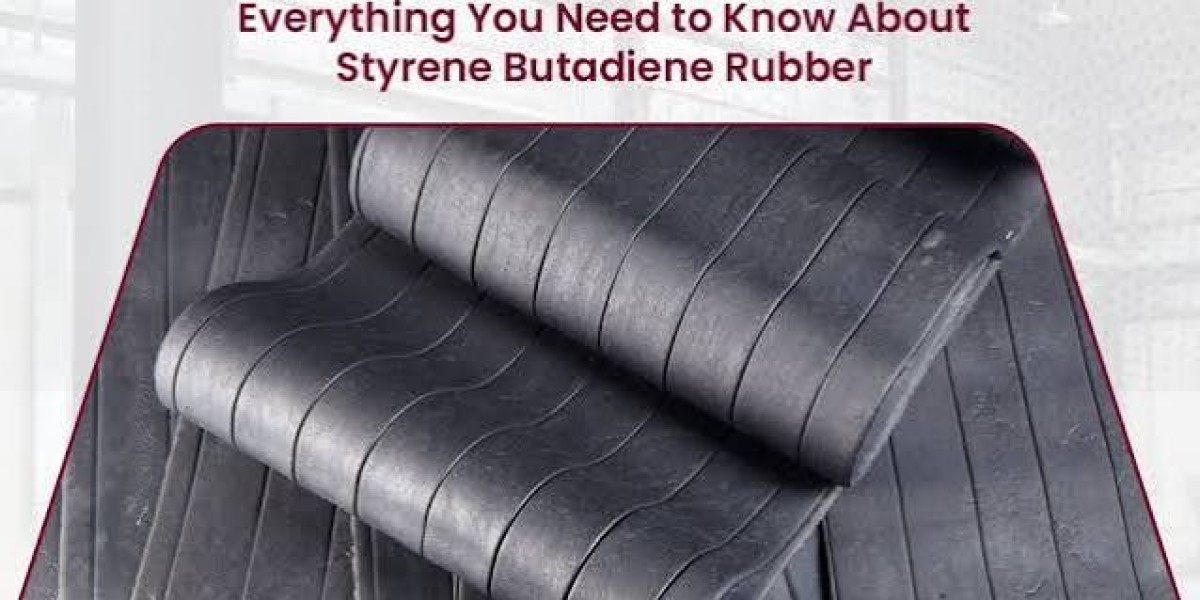

SBR, short for Styrene Butadiene Rubber, is one of the most widely used synthetic rubber materials in the world. Renowned for its excellent abrasion resistance, durability, and affordability, SBR has become a preferred material for manufacturing industrial products that require reliable mechanical performance.
From automotive tyres and conveyor belts to flooring systems and moulded rubber components, SBR offers an ideal combination of strength, flexibility, and wear resistance. Its versatility makes it suitable for industries ranging from automotive and construction to mining and general engineering.
At GB Gummi, we manufacture high-quality SBR rubber products that meet the performance requirements of modern industries. Our advanced manufacturing capabilities enable us to produce standard as well as customized SBR components for a wide range of industrial applications.
What Is SBR?
SBR is a synthetic elastomer produced by polymerizing styrene and butadiene. It was originally developed to provide an economical alternative to natural rubber while delivering consistent quality and improved wear resistance.
Today, SBR is used in countless industrial applications because it combines excellent mechanical properties with cost-effective production.
Products manufactured from SBR include:
Rubber sheets
Conveyor belts
Rubber mats
Gaskets
Bushes
Vibration pads
Industrial rollers
Custom moulded rubber parts
Its adaptability allows manufacturers to produce products for both light-duty and heavy-duty industrial environments.
Why Is SBR an Important Industrial Material?
Modern industries require rubber materials that can withstand continuous mechanical stress without significantly increasing production costs. SBR meets these requirements by providing reliable durability and consistent performance across various operating conditions.
Unlike specialty elastomers designed for niche applications, SBR offers an excellent balance between performance and affordability, making it one of the most widely used synthetic rubbers worldwide.
Some key reasons industries prefer SBR include:
High abrasion resistance
Good tensile strength
Excellent flexibility
Easy processing
Cost-effective manufacturing
Long service life
Properties of SBR
The popularity of SBR is largely due to its balanced physical and mechanical characteristics.
Excellent Abrasion Resistance
SBR performs exceptionally well in applications involving constant friction and wear.
Good Mechanical Strength
It maintains structural integrity under repeated mechanical loading.
High Elasticity
The material offers excellent flexibility and recovers well after deformation.
Reliable Water Resistance
SBR performs effectively in humid environments and moderate water exposure.
Easy Processing
It can be moulded, extruded, and fabricated into complex product designs.
Economical Material
SBR provides excellent value for manufacturers looking for durable synthetic rubber solutions.
Benefits of SBR
SBR offers numerous advantages for industrial manufacturers and end users.
Longer Product Life
High resistance to abrasion helps extend the service life of rubber components.
Lower Maintenance Costs
Durable products reduce replacement frequency and maintenance expenses.
Versatile Manufacturing
Suitable for compression moulding, injection moulding, transfer moulding, and extrusion.
Consistent Quality
Synthetic production ensures uniform product properties.
Excellent Cost-to-Performance Ratio
SBR delivers dependable performance without significantly increasing production costs.
Applications of SBR
SBR is used across multiple industries because of its durability and versatility.
Automotive Industry
Common applications include:
Tyres
Suspension components
Rubber mats
Anti-vibration parts
Bushings
Industrial Manufacturing
SBR is widely used for:
Conveyor belts
Rubber sheets
Rollers
Protective liners
Machinery components
Construction Industry
Applications include:
Rubber flooring
Expansion joints
Bridge pads
Vibration isolation systems
Mining Industry
Its abrasion resistance makes it suitable for:
Conveyor systems
Wear liners
Material handling equipment
Consumer Products
SBR is also found in:
Footwear soles
Sports surfaces
Rubber mats
Industrial accessories
Industries That Use SBR
SBR supports numerous industrial sectors because of its dependable mechanical performance.
Major industries include:
Automotive
Construction
Mining
Manufacturing
Agriculture
Transportation
Material handling
Engineering
Infrastructure
Its versatility makes it one of the most commonly specified synthetic rubber materials worldwide.
How Is SBR Manufactured?
The production of high-quality SBR products involves several carefully controlled manufacturing stages.
Polymer Production
Styrene and butadiene are polymerized under controlled conditions to produce synthetic rubber.
Compound Formulation
The polymer is blended with reinforcing fillers, curing agents, antioxidants, and processing additives to obtain the desired physical properties.
Mixing Process
The ingredients are mixed thoroughly to ensure a homogeneous compound.
Product Manufacturing
Depending on the application, the compound is processed through moulding, extrusion, or calendaring techniques.
Vulcanization
Heat curing improves strength, elasticity, and durability while enhancing long-term performance.
Quality Inspection
Every SBR product is tested for:
Hardness
Tensile strength
Elongation
Abrasion resistance
Dimensional accuracy
Surface quality
At GB Gummi, every product undergoes strict quality inspections before reaching customers.
How to Select the Right SBR Products
Choosing the right SBR product depends on the intended application and operating conditions.
Before selecting a product, consider:
Mechanical Requirements
Evaluate the expected load, pressure, and wear conditions.
Environmental Exposure
Assess exposure to water, temperature, and external conditions.
Product Design
Choose the correct dimensions and hardness for your application.
Manufacturing Quality
Reliable products come from manufacturers that maintain strict quality standards.
Technical Support
Working with experienced manufacturers ensures better product selection and long-term performance.
Why Choose GB Gummi for SBR Products?
Selecting the right manufacturing partner plays a major role in product reliability.
At GB Gummi, we combine engineering expertise with advanced manufacturing technologies to produce premium-quality SBR products for industrial customers.
Our strengths include:
Premium SBR compounds
Precision manufacturing
Customized product development
Advanced moulding technology
Comprehensive quality testing
Modern production facilities
Reliable delivery
Technical assistance for custom applications
Our commitment to quality enables customers to achieve dependable performance in demanding industrial environments.
Maintenance Tips for SBR Components
Proper maintenance extends the operational life of SBR products.
Recommended practices include:
Store products away from direct sunlight.
Keep components clean before installation.
Avoid prolonged exposure to excessive heat.
Inspect products regularly for wear.
Replace damaged components before equipment performance is affected.
Routine maintenance helps maximize product life and operational efficiency.
Future of SBR
As industries continue to demand durable, economical, and high-performance materials, SBR remains one of the most widely used synthetic elastomers. Improvements in rubber compounding technologies and manufacturing processes are enabling the development of stronger, more sustainable SBR products for modern industrial applications.
Growing investments in infrastructure, transportation, manufacturing, and automation will continue to drive demand for high-quality SBR products across global markets.
Conclusion
SBR has earned its position as one of the most reliable synthetic rubber materials because of its outstanding abrasion resistance, mechanical strength, flexibility, and cost-effectiveness. It supports a wide range of industries, including automotive, mining, construction, manufacturing, and engineering.
At GB Gummi, we manufacture premium-quality SBR products using advanced production technologies and rigorous quality control processes. Whether you need standard rubber components or customized engineering solutions, our expertise ensures products that deliver durability, precision, and long-term performance.
Frequently Asked Questions (FAQs)
What does SBR stand for?
SBR stands for Styrene Butadiene Rubber, a synthetic rubber known for its excellent abrasion resistance, durability, and cost-effective performance.
What are the main applications of SBR?
SBR is used in tyres, conveyor belts, rubber sheets, industrial flooring, gaskets, bushes, rollers, vibration pads, and various moulded rubber components.
What are the advantages of SBR?
SBR offers high abrasion resistance, good tensile strength, flexibility, easy processing, long service life, and excellent value for industrial applications.
Which industries commonly use SBR?
Automotive, construction, mining, manufacturing, transportation, agriculture, and engineering industries extensively use SBR products.
Why choose GB Gummi for SBR products?
GB Gummi manufactures premium SBR products using high-quality raw materials, advanced manufacturing processes, and strict quality control to deliver reliable and customized rubber solutions for diverse industrial applications.