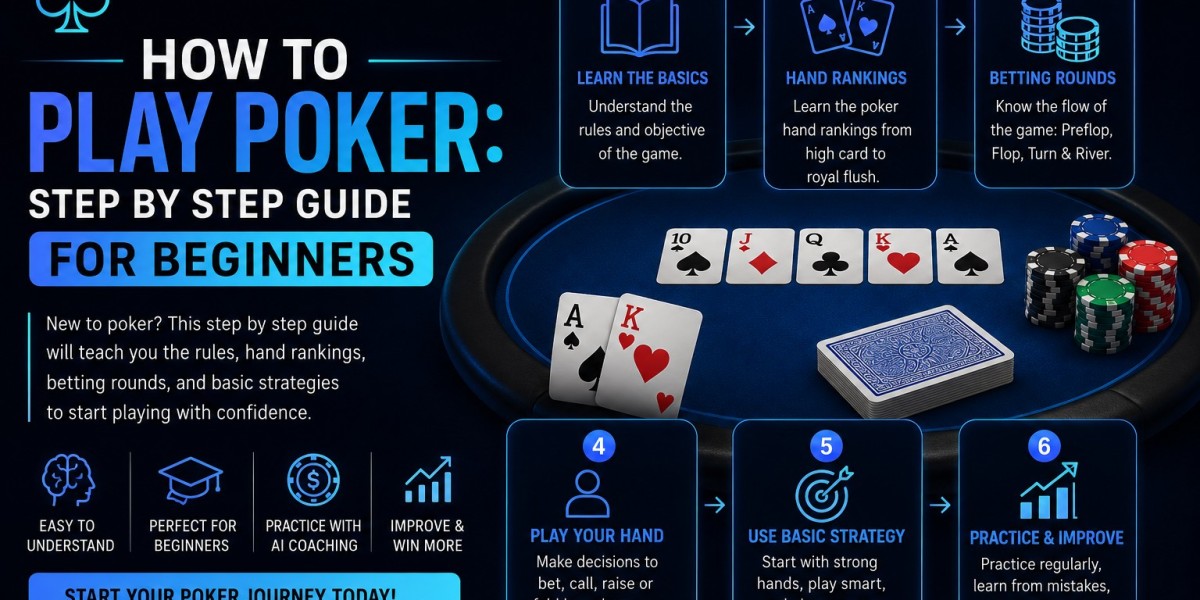

The players who improve fastest are not the ones who memorize the most theory. They are the ones who learn the rules, start playing, and focus on fixing the same handful of structural mistakes that every amateur makes. While poker actually refers to many different game variations, this comprehensive guide on how to play poker for beginners will focus heavily on Texas Hold’em, the world’s most popular variant and take you directly from the basic rules to the strategy habits that actually make you money.
How a No-Limit Hold'em Hand Works: Step by Step
No-Limit Hold’em is played with one standard 52-card deck. Your main goal in each hand is to win the pot, which is the total of all bets made. You win the pot if you make everyone fold before showdown, or if you have the best hand at showdown. If at any point only one player remains in the hand, that player wins the pot immediately without showing their cards.
Every definitive poker rules for beginners guide breaks a live hand down into these sequential steps:
Step 1: The Blinds Are Posted.
Before any cards are dealt, the two players to the left of the dealer button post forced bets called the small blind and the big blind (e.g., in a $1/$2 game, the small blind is $1 and the big blind is $2). These bets start the action.
Step 2: Each Player Receives Two Hole Cards
The dealer gives every player two private cards, face down. These are your hole cards. Only you can see them.
Step 3:Preflop Betting Round
Starting with the player to the left of the big blind and moving clockwise, each player chooses to fold, call the big blind, or raise.
Step 4:The Flop
The dealer reveals three community cards face-up in the center of the table. These are shared by all remaining players. Another betting round takes place.
Step 5:The Turn
A fourth community card is revealed face-up on the board. A third betting round follows immediately.
Step 6:The River
The fifth and final community card is revealed face-up. The final, crucial betting round takes place.
Step 7:The Showdown
If more than one player remains, they reveal their hole cards. The player with the best five-card hand using any combination of their two hole cards and the five community cards wins the pot.
The Core Poker Rules for Beginners
Before diving into chip stacks or psychological reads, you must understand the primary objective of a hand. In standard poker, your goal is to win the "pot" , the collective pool of chips wagered by all players during a single hand.
You can win the pot in one of two ways:
- Showdown Victory: Holding the highest-ranking five-card combination when all betting rounds are complete.
- Forcing Folds: Betting aggressively enough to convince all other players to discard their cards before a showdown occurs.
While there are dozens of popular variants, nearly every modern table shares the same underlying structure. Let's look at how a hand functions under standard poker rules for beginners, focusing on No-Limit Texas Hold'em, the absolute gold standard of the game.
Posting the Blinds: Pre-deal Setup
Before any physical cards are dealt, the two players directly to the left of the dealer button must post forced bets known as the Small Blind and Big Blind. This ensures there is always money in the pot to fight for.
Hole Cards Dispatched: The Deal
The dealer distributes two private, face-down cards to every individual player at the table. These are your hole cards, and they belong exclusively to you.
Preflop Action: Betting Round 1
Starting with the player directly to the left of the Big Blind, players take turns acting clock-wise. They can fold their cards, match the current big blind amount (call), or increase the stakes (raise).
The Flop: Round 2
The dealer places three community cards face-up in the center of the table. These cards are shared globally by all active players. A second round of betting takes place among the remaining players.
The Turn: Betting Round 3
A fourth community card is dealt face-up next to the flop. This card triggers a third round of betting, where stakes often escalate.
The River: Betting Round 4
The fifth and final community card is dealt face-up on the board. This sets off the final, highest-stakes round of betting.
The Showdown: The Climax
If two or more active players remain after the final river betting, they turn their hole cards face-up. The player who can construct the absolute best five-card hand out of their two private cards and the five community cards wins the pot.
The 5 Basic Poker Moves Every Beginner Must Know
To master texas holdem poker for beginners, you must understand the core vocabulary of the game. In every betting round, each active player can take one of these actions when it is their turn:
- Fold: Discard your hand and exit the pot. You lose chips already invested, but you risk no more. Fold when calling or raising costs more than your hand's equity is worth.
- Call: Match the current highest bet to stay in the hand. This makes sense when you have the correct odds to see the next card cheaply.
- Raise: Increase the size of the current bet. This builds the pot when you have a strong hand and puts pressure on marginal opponents.
- Check: Pass the action to the next player without betting. You can only check when no one else has bet yet in the current round.
- Bet: Place chips in the pot when no one else has bet yet, setting the price for everyone else to continue.
- All-In: Bet all of your remaining chips.
How Do You Read Poker Hand Rankings?
To play effectively, you must memorize the traditional hierarchy of card values. Every reputable guide targeting poker for beginners starts here. Suits hold equal mathematical value; what matters is the specific pattern and tier of your final five-card combination.
Tier | Hand Name | Structural Description | Example |
1 | Royal Flush | A, K, Q, J, 10 of the exact same suit. | A♣ K♣ Q♣ J♣ 10♣ |
2 | Straight Flush | Five consecutive cards of the same suit. | 9♦ 8♦ 7♦ 6♦ 5♦ |
3 | Four of a Kind | Four cards of identical numerical or face rank. | A♠ A♥ A♦ A♣ K♠ |
4 | Full House | Three matching cards of one rank plus a pair of another. | K♥ K♦ K♠ 10♣ 10♦ |
5 | Flush | Any five cards of the identical suit, non-consecutive. | Q♠ 9♠ 7♠ 4♠ 2♠ |
6 | Straight | Five consecutive cards of mixed, unmatching suits. | 8♦ 7♥ 6♣ 5♠ 4♦ |
7 | Three of a Kind | Three cards of the identical rank. | J♠ J♦ J♣ A♥ 4♣ |
8 | Two Pair | Two completely distinct pairs in a single hand. | Q♣ Q♦ 9♥ 9♠ 2♦ |
9 | One Pair | Two cards matching in rank. | 10♦ 10♣ A♠ K♥ 5♦ |
10 | High Card | No matching pairs or connections; ranked by highest single card. | Ace-High (A♣ Q♦ 7♠ 4♥ 2♣) |
Tiebreaker Note: If two players hold the same tier of hand at showdown (e.g., both hold One Pair), the player with the higher ranking pair wins. If the pairs are identical, the highest non-paired card in their five-card combination (known as the "kicker") breaks the tie.
Fundamental Poker Strategy for Beginners
The biggest difference between a casual player and a winning professional comes down to deliberate decision-making. If you want to fast-track your progress, implement this basic poker strategy for beginners:
Preflop Selectivity (The Power of Tight Play)
Amateurs play almost every hand out of boredom. A winning strategy requires you to fold roughly 75% to 80% of the hands you are dealt before the flop ever arrives.
- Premium Hands to Play: Large pocket pairs (A-A, K-K, Q-Q, J-J) and high-value connection cards like Ace King suited.
- Trash Hands to Fold: Unsuited, disconnected cards like Jack-Four, Nine-Two, or Eight-Three.
Understanding Table Position
"Position" refers to where you sit relative to the dealer button. The closer you are to the left of the button, the earlier you must act. Acting early is an extreme disadvantage because you must make decisions with zero data. Acting last (sitting "in position" on or near the button) allows you to see how every other player handles their cards before you risk a single chip.
Effective Stack Sizes
In poker, you can only lose the chips you have directly in front of you. The smaller of two stacks in a heads-up pot determines the maximum risk for both players. That is your effective stack size.
- Short Stack (25 or fewer Big Blinds): Your post-flop options are highly constrained. Your main play becomes an all-in or fold preflop strategy.
- Deep Stack (100 or more Big Blinds): Gives you full strategic freedom. Speculative hands like suited connectors increase significantly in value because your potential payout is much higher.
Top Practical Tips for Poker Beginners
Transitioning from theory to real-world execution can feel overwhelming. Keep these foundational tips for poker beginners pinned to your mental dashboard during your first few sessions:
- Stop Bluffs for Now: Hollywood movies make it seem like poker is entirely about high-stakes bluffing. In reality, bluffing down to the river is a quick way to lose your bankroll as a newcomer. Focus instead on "value betting", betting big when you hold a strong hand so weaker hands are forced to pay you.
- Observe Betting Sizing: Pay close attention to how much your opponents wager. If a player who usually bets small suddenly shifts to an massive, aggressive bet, they likely hold a premium monster hand. Respect the strength of their chips.
- Manage Emotional Swings (Tilt): Bad luck happens. A weaker player will occasionally hit a lucky card on the river to beat you. Avoid "tilting" , the poker term for letting anger cloud your logic and cause reckless play.
- Use a Dedicated Application: One of the safest methods to build raw pattern recognition is to utilize a dedicated poker app for beginners. Free-play platforms allow you to experience thousands of hands, memorize rules, and read board textures instantly without risking your hard-earned money.
How Game Formats Impact Your Poker Bankroll Strategy
Cash Games vs. Tournaments
No-Limit Hold’em is played in two distinct formats:
- Cash Games: Every chip has a direct dollar value. You can stand up and cash out your chips at any given moment, and the blinds never change.
- Tournaments: You pay a fixed entry fee for a set number of chips. These chips represent your survival in the field rather than direct cash value. The blinds scale upward at regular intervals, forcing action. Payouts occur once roughly top 10% to 15% of the field remains.