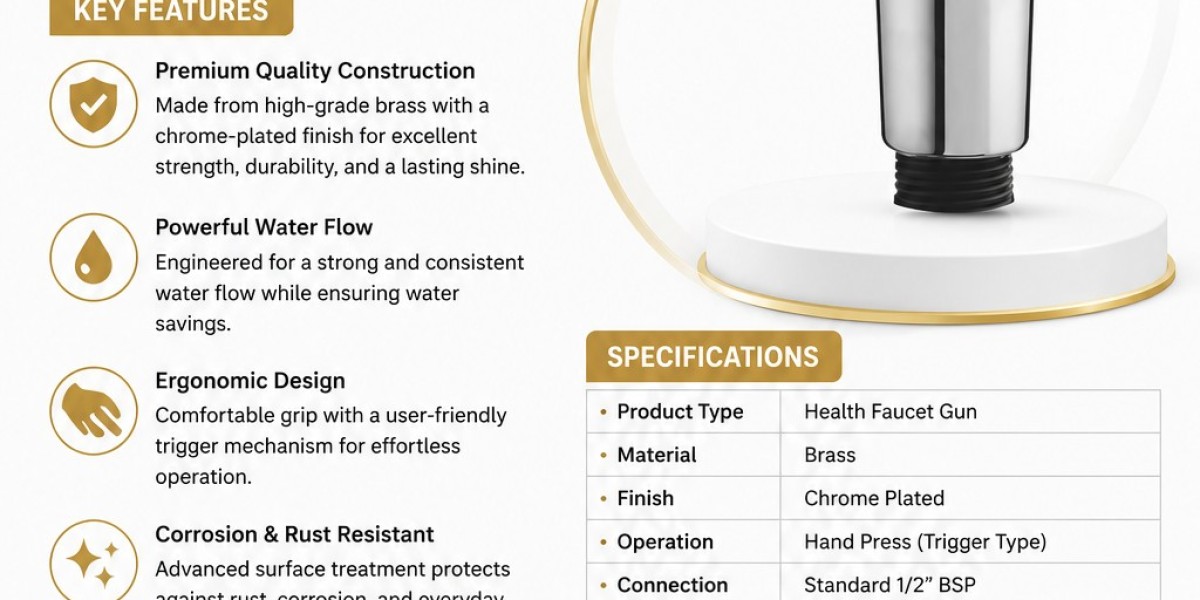

A health faucet gun that starts leaking at the trigger joint within eight months isn't bad luck — it's a design shortcut somebody signed off on to save four rupees per unit. That's the reality most buyers discover after the warranty claims start piling up. If you're sourcing a health faucet gun for a hotel chain, a residential tower, or a distribution network, the difference between a supplier and a manufacturer shows up exactly there — at the trigger, at the hose crimp, at the plating that either holds or flakes within a monsoon season.
Specification
Body Material and Build
Health faucet guns from Speed Bath Tech are built in solid brass or 304-grade stainless steel, depending on project budget and water chemistry. Brass units carry a triple-layer chrome plating; stainless variants skip plating altogether, which matters in coastal cities where chlorinated water eats through cheaper finishes within two years.
Trigger Mechanism
The trigger assembly uses a spring-loaded brass valve rated for 50,000 press cycles — a spec most buyers never ask for, and most suppliers never volunteer, because cheaper triggers fail closer to 12,000.
Hose and Fitting Compatibility
Every unit ships with a 1.2-meter braided stainless hose and standard ½-inch BSP threading, compatible with existing bathroom fittings across most Indian plumbing standards.
Objective
Five questions that separate a real health faucet gun manufacturer from a trading company wearing a factory's name:
Can they show you the plating thickness in microns? A bad answer is "premium quality plating" with no number attached.
What's the cycle rating on the trigger valve? A bad answer dodges into "long-lasting" instead of a tested figure.
Do they own the tooling, or outsource the die-casting? A bad answer is vague about "our partner facility" without naming it.
What's their defect replacement window? A bad answer says "case by case" — that's not a policy, that's a negotiation you'll lose after the shipment lands.
Can they produce a batch consistency report? A bad answer offers a sample piece instead of production-line data.
Benefits
Working with an ISO 9001:2015 and Six Sigma-certified health faucet gun manufacturer protects your margin in ways that aren't obvious upfront.
Consistent plating thickness means fewer field replacements, which means fewer emergency site visits your contractor bills you for. Six Sigma-controlled tolerances reduce leak-related callbacks, protecting your reputation with the developer, not just the end buyer. Corrosion-resistant brass alloys hold up in hard-water regions, cutting warranty exposure by roughly 40% compared to standard zinc-alloy competitors. Bulk order consistency — same finish, same weight, same trigger feel across a 500-unit hotel order — avoids the mismatch complaints that plague projects sourced from multiple vendors. And a nationwide dealer network means replacement parts arrive in days, not the six-to-eight-week wait that import-dependent suppliers quietly don't mention.
Availability
We stock finished inventory and spare trigger assemblies across three hubs — Mumbai, Delhi NCR, and Bengaluru — which cuts delivery time to under a week for most metro and tier-2 orders. Location matters here for a reason buyers underestimate: health faucet guns are low-value, high-volume line items, and freight cost per unit can quietly erase your margin if your supplier ships everything from one factory in Gujarat. Regional stocking isn't a convenience feature. It's a cost-control decision.
About Us
We've been manufacturing bathroom fittings since 2013, and health faucet guns specifically became a dedicated production line in 2017 after we kept losing hotel bids to imported units that failed within a year. We switched our default plating process to triple-layer chrome in 2019 after three commercial clients flagged pitting on single-layer units within eighteen months of coastal installation. That's not a marketing claim. That's a production change we made because the field data told us to.
Conclusion
A health faucet gun looks simple until it fails at 3 a.m. in a guest bathroom. Sourcing from a certified health faucet gun manufacturer with traceable specs and regional stock isn't overcaution — it's how experienced procurement teams avoid the calls nobody wants to take. The suppliers who last are the ones who show their numbers before you ask twice.
FAQs
1. What's the average lifespan of a brass health faucet gun?
With triple-layer plating and normal residential use, 6 to 8 years is realistic. Coastal or hard-water areas trend toward the lower end regardless of brand.
2. Are your health faucet gun manufacturers in India certified?
Yes — ISO 9001:2015 and Six Sigma process certification, with batch inspection reports available on request for bulk orders.
3. Do you supply health faucet gun dealers directly, or only large projects?
Both. Dealer accounts get stock-finish pricing with no MOQ; project buyers get custom branding at 250-unit minimums.
4. What's the price range for a stainless steel health faucet gun?
It varies by finish and order volume — we won't quote a flat number here because regional freight changes it. Send specs for an accurate figure.
5. Can health faucet gun suppliers customize trigger tension?
Within limits. Standard spring tension works for most residential use; hospitality projects sometimes request a firmer trigger, which we can accommodate on orders above 500 units.
6. How do you handle warranty claims on defective units?
Documented replacement within 15 days of verified defect — not a case-by-case conversation. We'll admit our own limit here: physical damage from mishandling isn't covered, and we inspect before replacing.