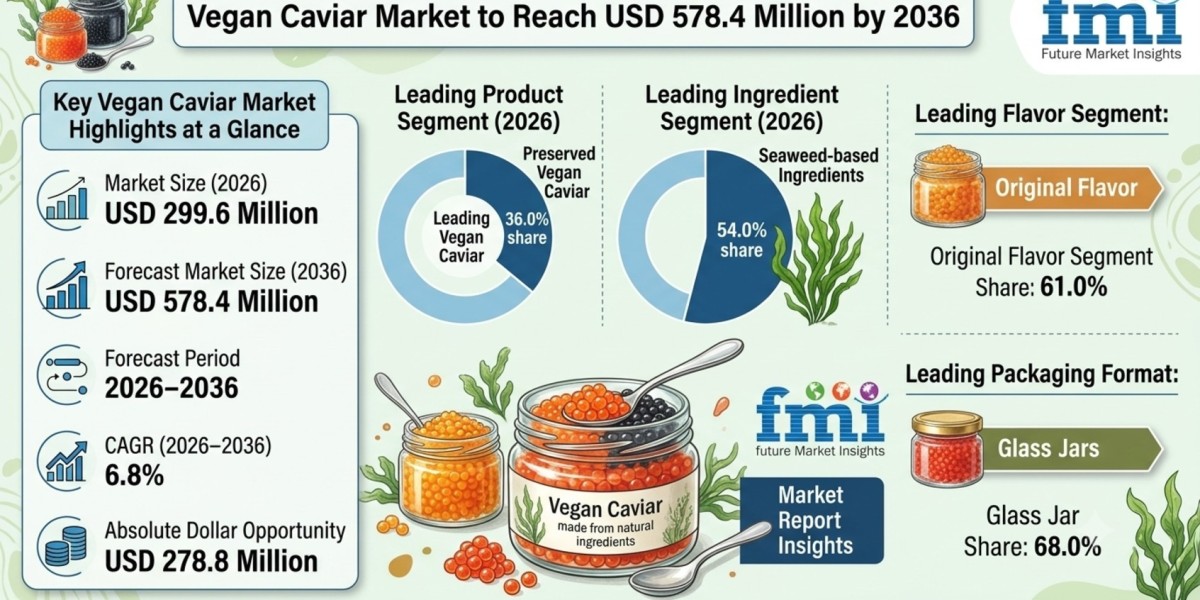

The global vegan caviar market is entering a new phase of mainstream expansion as consumers increasingly prioritize sustainable luxury, plant-based alternatives, and ethical culinary innovations. According to latest insights by future market insights, the market is projected to grow from USD 299.6 million in 2026 to USD 578.4 million by 2036, registering a robust 6.8% CAGR during the forecast period. The category is rapidly evolving from a niche culinary curiosity into a well-established specialty food segment supported by high-end retail expansion, fine dining adoption, and increasing consumer awareness surrounding sturgeon overfishing and marine conservation.
The market is expected to create an absolute dollar opportunity of USD 278.8 million between 2026 and 2036. Growth is being fueled by wider availability across gourmet stores, premium supermarkets, and online marketplaces, alongside continuous innovation in flavors, clean-label plant formulations, and advanced molecular spherification technologies.
Request a Sample Report: https://www.futuremarketinsights.com/reports/sample/rep-gb-14418
Key Vegan Caviar Market Highlights at a Glance
· Market Size (2026): USD 299.6 Million
· Forecast Market Size (2036): USD 578.4 Million
· Forecast Period: 2026–2036
· CAGR (2026–2036): 6.8%
· Absolute Dollar Opportunity: USD 278.8 Million
· Leading Product Segment: Preserved Vegan Caviar
· Preserved Vegan Caviar Market Share (2026): 36.0%
· Leading Ingredient Segment: Seaweed-based Ingredients
· Seaweed-based Segment Share (2026): 54.0%
· Leading Flavor Segment: Original Flavor
· Original Flavor Segment Share: 61.0%
· Leading Packaging Format: Glass Jars
· Glass Jar Share: 68.0%
· Leading End Use Segment: Household
· Household End Use Share: 57.0%
· Fastest-Growing Country: United States
· USA CAGR: 7.1%
· Report Pages: 306
Why Is the Vegan Caviar Market Growing?
Several structural shifts in the global specialty food industry are driving sustained demand for plant-based caviar alternatives.
Key Growth Drivers
· Rising premiumization of plant-based specialty foods, positioning vegan caviar at the luxury tier of sustainable gastronomy.
· Increasing consumer willingness to invest in high-quality alternatives that recreate the sensory and social experiences of upscale dining.
· Rapid adoption by professional chefs in fine dining, boutique hospitality, and luxury catering settings as a versatile plating garnish.
· Growing environmental consciousness regarding wild sturgeon populations, overfishing, and the ecological impacts of conventional aquaculture.
· Advanced utilization of sodium alginate and kelp extraction technologies to perfectly replicate the classic bead-like appearance and pop of real roe.
· Ongoing flavor diversification, expanding from traditional ocean-like profiles into premium infused variants such as truffle, smoked, lemon, and wasabi.
As vegan caviar secures endorsements from high-profile culinary institutions, producers are successfully scaling distribution beyond health-food shops into mainstream luxury retail.
"Producers who are able to combine true textural replication with premium branding and multi-channel distribution across fine-dining, specialty retail and e-commerce are well-positioned to take share as vegan caviar moves from novelty to an established specialty food category."
Which Product Segment Leads the Vegan Caviar Market?
Preserved Vegan Caviar continues to lead the category framework because it strikes the ideal balance between functional commercial handling and high-end presentation expectations.
Advanced food preservation techniques like controlled pasteurization and strict pH management allow manufacturers to deliver long shelf lives without compromising product structure. This operational efficiency simplifies global shipping networks and helps premium grocers maintain consistent inventory on high-visibility display shelves.
Product Segment Highlights
· Preserved Vegan Caviar leads the landscape with a 36.0% market share in 2026.
· Extended shelf stability addresses rigorous logistics requirements across retail and foodservice supply networks.
· Standard glass jar configurations seamlessly reinforce pricing strategies for affordable luxury branding.
· Serves as the primary baseline format for testing modern flavor-infused innovations.
Why Do Seaweed-based Ingredients Command the Industry Base?
Seaweed-based formulations dominate the processing structure due to their natural alignment with the physical and aromatic characteristics of conventional fish eggs.
Extracts derived from kelp and marine algae provide the precise elasticity required for advanced spherification chemistry, yielding uniform pearls that burst convincingly upon consumption. Furthermore, the natural briny undertones of seaweed extracts minimize the need for heavy artificial flavor masking.
Ingredient Segment Highlights
· Seaweed-based formulations dictate 54.0% of the raw material demand.
· Natural sodium alginate behavior acts as the technical foundation for premium texture replication.
· Clean-label attributes appeal directly to health-conscious gourmet buyers.
· Familiarity with marine flora ingredients supports strong consumer and regulatory acceptance globally.
Why Is Home Entertaining Powering End-Use Volume?
The household application segment commands the majority of consumption volume as personal home entertaining and upscale lifestyle trends continue to expand.
While fine-dining restaurants and high-end catering operations serve as essential channels for generating macro media visibility and brand validation, retail consumer purchases for special home meals and celebratory events provide the baseline market stability.
End Use Segment Highlights
· Household procurement represents 57.0% of total industry demand.
· Driven heavily by consumer investment in specialty ingredients for personal holiday meals and host entertainment.
· Strongly aligned with the premiumization of e-commerce delivery models and direct-to-consumer gourmet subscriptions.
· Original flavor selections lead home consumption at 61.0% due to traditional serving preferences.
How Are Premium Packaging Choices Anchoring Market Value?
Glass jar specifications remain central to protecting delicate plant-based pearls while maintaining standard aesthetic associations linked to old-world luxury foods.
Although flexible film packets and vacuum pouches are increasingly utilized for back-of-house restaurant storage or bulk shipping, consumer-facing products rely heavily on premium glass structures to justify top-tier price positions.
Custom Research Available: https://www.futuremarketinsights.com/customization-available/rep-gb-14418
Packaging Segment Highlights
· Glass jars represent 68.0% of the global packaging landscape.
· Vital for ensuring structural stability and protecting sensitive spheres from transport compression.
· Essential for reinforcing artisanal and luxury heritage branding across elite retail counters.
· Fully compliant with strict regional retail regulations favoring recyclable and premium materials.
Market Dynamics
Market Drivers
The convergence of plant-based dietary shifts and active luxury lifestyle patterns is creating strong demand for sustainable, gourmet menu items. Vegan caviar capitalizes on this behavioral overlap by offering an uncompromising, sophisticated dining option that removes all ethical and environmental friction.
Market Restraints
Relatively low baseline consumer awareness and initial skepticism regarding the quality of plant-based seafood alternatives act as commercial growth head-winds. Overcoming these adoption hurdles requires active capital investment in experiential retail sampling, social media marketing campaigns, and collaborative chef endorsement strategies.
Market Trends
Culinary creativity continues to reshape the operational canvas.
Major trends include:
· Development of specialty occasion-specific flavor infusions like truffle and smoked profiles.
· High-density distribution partnerships with boutique urban convenience channels.
· Aligning label declarations with strict international vegan certification rules.
· Use of sustainable eco-packaging to match core environmental brand values.
· Broadening premium food hall placements inside high-end metropolitan department stores.
Regional and Country Outlook
Country Growth Rates
- United States — 7.1% CAGR
- South Korea — 6.9% CAGR
- European Union — 6.8% CAGR
- United Kingdom — 6.7% CAGR
- Japan — 6.5% CAGR
The United States represents the fastest-growing market country through 2036, propelled by an established infrastructure for alternative proteins and deep specialty retail chains like Whole Foods. Creative chef innovations across culinary capitals like New York and San Francisco consistently drive mainstream media visibility and consumer adoption.
South Korea follows closely with a 6.9% CAGR, supported by a rapid innovation culture and premium retail distribution channels that favor single-serve, upscale specialty lines.
Across the European Union, early-adopter consumer populations in Germany, Scandinavia, and the Netherlands provide a solid revenue foundation, while clear EU novel food labeling guidelines offer transparent market entry criteria for new product launches.