
At 6 PM on a Saturday in a large shopping centre in Ghaziabad, the atrium is packed while the back‑of‑house zones are nearly empty. HVAC runs at full capacity across all floors, lighting stays bright in unoccupied corridors, and energy bills climb. The facility manager asks: how does a BMS for shopping centres work to balance guest comfort with energy efficiency across diverse zones and shifting occupancy?
A Building Management System is the integrated platform that monitors, controls, and optimises HVAC, lighting, power, fire, and security systems. For shopping malls and retail complexes, smart building control and energy management are critical due to vast floor areas, mixed tenants, and peak‑hour congestion. Understanding what is a BMS system—and how it adapts to retail dynamics—helps owners deliver comfort, safety, and measurable energy savings.
How a Building Management System Works in Shopping Centres
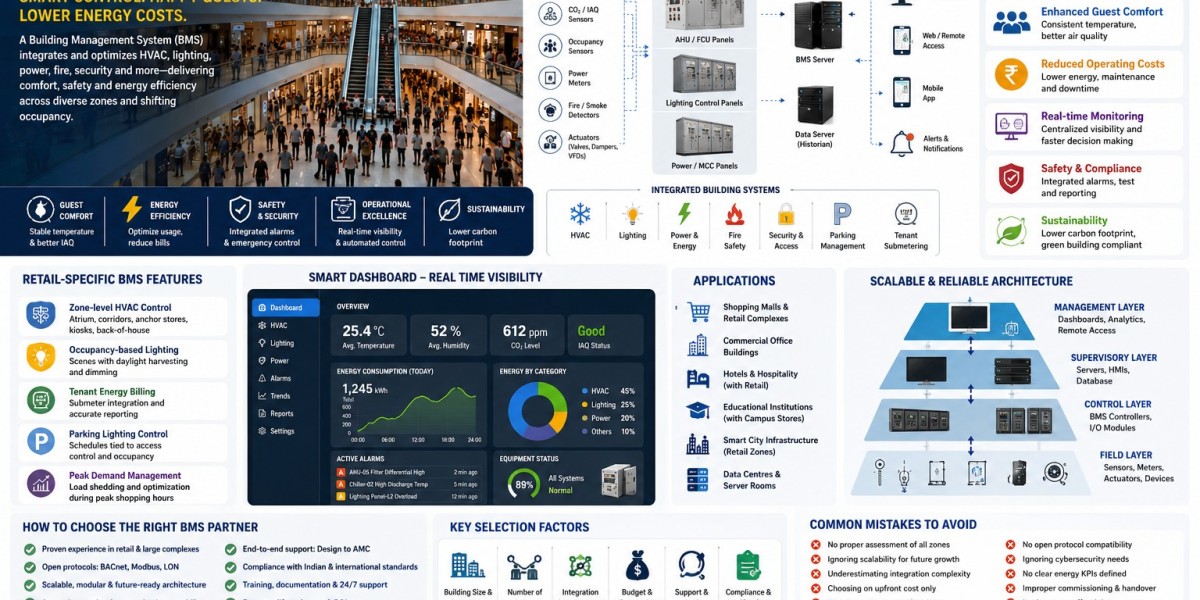
A BMS in shopping centres uses layered architecture. Field devices—temperature sensors, CO2 monitors, occupancy detectors, power meters, and actuators—feed distributed controllers housed in BMS control panels near AHUs, chillers, and lighting panels. These controllers execute HVAC automation and control loops, modulating valves, dampers, and fans based on real‑time setpoints and feedback.
Lighting management systems integrate occupancy sensors, daylight harvesting, and scheduled scenes across retail zones, corridors, and parking. BMS lighting control systems lower consumption by dimming or switching off lights in unoccupied areas. Power monitoring and energy optimization track usage by tenant, floor, or major equipment, supporting peak shaving and load‑shedding strategies.
Fire safety system integration uses supervised alarm inputs and smoke control sequences to manage stair pressurisation and exhaust fans. Access control and security integration enables correlated events—ventilation purge on contamination or zone lockdown on security triggers. Real‑time data monitoring and alerts notify teams of sensor drift, equipment faults, or energy anomalies within seconds.
Remote Access and Multi‑Tenant Integration
Remote access and cloud‑based management deliver dashboards for multi‑site visibility, benchmarking, and machine‑learning fault detection. Multi‑system integration principles rely on open protocols (BACnet, Modbus, LON) to connect retailer submeters, parking access systems, and CCTV. Centralized building control concepts are achieved through this hierarchy: field devices feed controllers, controllers feed servers, servers feed HMIs.
Occupant comfort and safety management are validated through setpoint stability, IAQ monitoring, and emergency sequence testing. Regulatory and energy compliance standards are supported via automated reporting and verifiable data. Modern BMS engineering advancements include edge analytics at controllers and IoT‑friendly sensors that simplify retrofits in existing malls.
Key Features That Define the Best BMS for Retail
The best BMS systems for shopping centres deliver scalable system architecture for phased expansion, HVAC monitoring and advanced control logic, energy consumption tracking with tenant submetering, real‑time alerts and mobile notifications, remote access and mobile compatibility, multi‑system integration capability, user‑friendly dashboard interfaces, predictive maintenance support, low maintenance requirements, long operational life, energy‑efficient performance, modular system design, and reliable 24/7 operation with redundancy options.
Retail-specific features include:
Zone‑level HVAC control for atrium, corridors, and tenant spaces
Occupancy‑based lighting scenes with daylight harvesting
Tenant energy billing through submeter integration
Parking area lighting schedules tied to access control
Peak demand management during shopping hours
Applications Where BMS Delivers Highest Retail Value
Shopping malls and retail chains are the primary application, but BMS also serves commercial office buildings within mixed‑use complexes, hotels and hospitality facilities with retail components, educational institutions with campus stores, and smart city infrastructure包含 retail zones. In data centres and server rooms supporting e‑commerce operations, a data center BMS system ensures thermal stability.
System Selection Factors for Shopping Centre BMS
Selection depends on building size and complexity, number of control points and sensors across vast floors, type of BMS architecture (distributed preferred for resilience), brand and technology selection, system integration requirements with tenant meters and parking systems, software and licensing fees, installation and commissioning charges, after‑sales support and AMC costs, customization for tenant billing reports, location and project logistics, compliance and certification requirements, and lifecycle cost considerations.
Buyer’s Guide for India: Choosing a BMS Company
Evaluate vendors on industry experience in retail projects, building automation engineering expertise, manufacturing/integration capabilities, testing and validation procedures, compliance certifications, open protocol compatibility (BACnet, Modbus, LON), product customization for tenant billing, technical support availability, installation/commissioning assistance, maintenance and AMC services, documentation/training quality for facility staff, and long‑term system reliability. A capable BMS company understands local codes and logistics.
When planning BMS system installation for shopping centres, align early with your BMS company and MEP consultants. Define zone schedules, tenant metering requirements, and acceptance criteria so control strategies deliver measured energy savings. For guidance on deployment and detailed services, review a professional provider’s approach to Building Management System integration. BMS maintenance services sustain performance through fault detection and periodic validation.
A Sigma Power Tech BMS system can be configured with modular components and retail-specific control logic to match your shopping centre’s scale, compliance needs, and energy targets.
Common Mistakes That Reduce Retail BMS Value
Avoid selecting systems without proper building assessment across all zones, ignoring scalability for future retail expansions, underestimating integration complexity with tenant meters and parking systems, choosing equipment solely on upfront cost, overlooking maintenance and AMC planning, neglecting open protocol compatibility, ignoring cybersecurity requirements for guest networks, failing to define clear energy KPIs before design, improper commissioning and handover procedures, and inadequate staff training on BMS operation for retail operations.
Conclusion
A BMS for shopping centres works by layering field sensors, distributed controllers in BMS control panels, and supervisory servers to deliver zone‑level HVAC control, occupancy‑based lighting, tenant energy tracking, and integrated safety systems. Proper selection, open protocols, and verified commissioning ensure guest comfort, measurable energy savings, and resilient smart building infrastructure. Focus on engineering quality to maximise long‑term ROI from your Building Management System in retail environments.