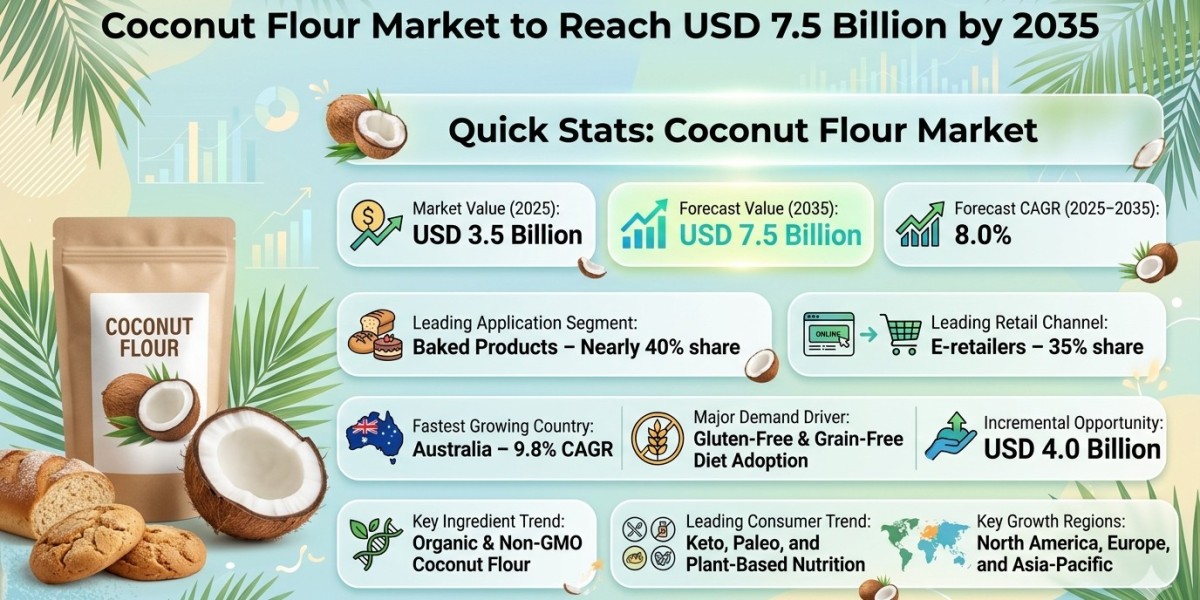

The global coconut flour market is projected to expand from USD 3.5 billion in 2025 to USD 7.5 billion by 2035, registering a compound annual growth rate (CAGR) of 8.0% during the forecast period. Market growth is being driven by increasing consumer preference for gluten-free and grain-free food products, rising adoption of keto and paleo diets, and growing demand for high-fiber clean-label baking ingredients across retail and industrial food applications.
The coconut flour industry is transitioning from a niche health-food ingredient category into a mainstream functional food ecosystem supported by plant-based nutrition trends, e-commerce retail expansion, and rising awareness regarding minimally processed flour alternatives.
Unlike conventional wheat-based flours, coconut flour is increasingly being positioned as a nutrient-rich alternative with low carbohydrate content, high dietary fiber, and allergen-friendly properties suitable for modern health-conscious consumers.
Quick Stats: Coconut Flour Market
• Market Value (2025): USD 3.5 Billion
• Forecast Value (2035): USD 7.5 Billion
• Forecast CAGR (2025–2035): 8.0%
• Incremental Opportunity: USD 4.0 Billion
• Leading Application Segment: Baked Products – Nearly 40% share
• Leading Retail Channel: E-retailers – 35% share
• Fastest Growing Country: Australia – 9.8% CAGR
• Major Demand Driver: Gluten-Free & Grain-Free Diet Adoption
• Key Ingredient Trend: Organic & Non-GMO Coconut Flour
• Leading Consumer Trend: Keto, Paleo, and Plant-Based Nutrition
• Key Growth Regions: North America, Europe, and Asia-Pacific
The coconut flour market is evolving from specialty organic retail shelves into a broader packaged food and functional nutrition category supported by digital retail penetration, premium ingredient positioning, and increasing health-focused consumer awareness.
Manufacturers are increasingly focusing on sustainable coconut sourcing, organic certifications, innovative flour processing technologies, and diversified retail distribution strategies to strengthen long-term market competitiveness.
Market Share Across Functional Food Ecosystem
• Gluten-Free Flour Market: ~10–13% share
• Functional Baking Ingredients Industry: ~6–8% share
• Plant-Based Food Ingredients Market: ~5–7% share
• Keto & Paleo Nutrition Industry: ~8–10% share
• High-Fiber Food Ingredients Segment: ~4–6% share
These figures highlight coconut flour’s growing strategic importance within functional nutrition, alternative baking ingredients, and clean-label food ecosystems.
Key Growth Drivers
• Rising Demand for Gluten-Free Food Products: Growing awareness regarding gluten intolerance and celiac disease is accelerating adoption of coconut flour as a wheat substitute
• Expansion of Keto and Paleo Diets: Consumers seeking low-carb and high-fiber nutrition solutions are increasingly integrating coconut flour into daily meal planning
• Growth of Plant-Based and Clean-Label Food Trends: Natural, minimally processed, and allergen-friendly ingredients are strengthening demand across bakery and snack categories
• Rapid E-Commerce Expansion: Online retail platforms are improving accessibility to premium organic and specialty coconut flour products globally
Technological Advancements & Processing Innovation
The coconut flour market is witnessing transformation through advanced processing technologies and ingredient optimization systems:
• Improved wet-process coconut flour extraction methods
• Enhanced fresh-dry processing technologies for better texture consistency
• Moisture-control and shelf-life optimization systems
• High-fiber and low-fat flour refinement technologies
Manufacturers are increasingly integrating efficient processing systems, traceable sourcing frameworks, and quality-control technologies to improve product consistency, scalability, and nutritional value.
Product Innovation Trends
Manufacturers are expanding innovation pipelines with:
• Organic and non-GMO coconut flour variants
• Protein-enriched coconut flour blends
• Low-fat high-fiber coconut flour systems
• Coconut flour baking mixes for gluten-free consumers
• Functional snack and extruded product formulations
These developments are supporting rising demand for convenient, health-focused, and premium plant-based food ingredients globally.
Packaging & Retail Transformation
The market continues to witness major innovation in packaging and retail distribution strategies:
• Resealable moisture-resistant packaging formats
• Eco-friendly biodegradable pouches and paper bags
• Transparent packaging for ingredient visibility
• Single-serve and portion-controlled packaging solutions
Improved packaging convenience, sustainability initiatives, and online retail optimization are increasingly influencing purchasing decisions among modern consumers.
Segmental Insights
Baked Products Application Segment
Baked products are expected to capture nearly 40% of total application demand during the forecast period, making it the dominant application category.
Strong consumer demand for gluten-free bread, muffins, cookies, cakes, and dessert mixes is accelerating the integration of coconut flour into mainstream bakery formulations.
E-Retail Segment
E-retailers are projected to account for nearly 35% of total retail sales, supported by growing online grocery adoption and rising demand for niche organic and specialty health products.
Consumers are increasingly utilizing online platforms to compare ingredient transparency, organic certifications, and non-GMO product options.
Organic Coconut Flour Segment
Organic coconut flour continues to witness strong premium demand as health-conscious consumers increasingly prioritize traceable sourcing, clean-label claims, and minimally processed food ingredients.
Regional Outlook
The United States remains a major coconut flour market supported by strong demand for gluten-free baking ingredients, keto nutrition products, and plant-based food alternatives.
Germany is emerging as a key European growth market driven by expanding vegan communities, rising clean-label food demand, and strong adoption of alternative baking ingredients.
Australia is projected to witness the fastest growth globally with a CAGR of 9.8% through 2035, supported by increasing health awareness and strong consumer preference for low-carb and functional food products.
Japan continues to witness stable demand growth due to rising interest in premium health foods, low-carb diets, and Western-style baking culture.
China is experiencing increasing market penetration through expanding e-commerce platforms, rising wellness awareness, and growing interest in plant-based nutrition.
Asia-Pacific overall is expected to remain a strategically important production and consumption hub due to strong coconut availability and expanding health-food retail ecosystems.
? Get Access to the Report Sample: https://www.futuremarketinsights.com/reports/sample/rep-gb-2479
Competitive Landscape
The global coconut flour market remains highly competitive, with leading companies focusing on sustainable sourcing, premium ingredient positioning, and scalable production infrastructure.
Leading Coconut Flour Manufacturers
• Celebes Coconut Corporation
• Nutiva Inc.
• Bob's Red Mill Natural Foods
• Primex Coco Products
• The Coconut Company
Manufacturers are increasingly investing in USDA Organic certifications, Non-GMO positioning, advanced processing capabilities, and e-commerce expansion to strengthen long-term market share.
Future Outlook
The coconut flour market is expected to witness sustained long-term growth, supported by:
• Expansion of gluten-free and grain-free food ecosystems
• Rising adoption of keto and plant-based dietary lifestyles
• Increasing demand for clean-label baking ingredients
• Growth of e-commerce and direct-to-consumer retail channels
• Technological advancements in flour processing and packaging
• Expansion of sustainable and traceable coconut sourcing programs
As consumers increasingly prioritize digestive wellness, low-carb nutrition, and minimally processed food ingredients, coconut flour is expected to strengthen its role across bakery, snack, functional nutrition, and plant-based food ecosystems globally.
About the Market
The coconut flour market represents a rapidly expanding segment within the global gluten-free foods, functional ingredients, and plant-based nutrition industries. Its growing role in clean-label baking, health-focused snack formulations, and alternative flour systems positions it as a strategically important category across retail food, industrial processing, and wellness nutrition ecosystems.
See Full Report View: https://www.futuremarketinsights.com/reports/coconut-flour-market