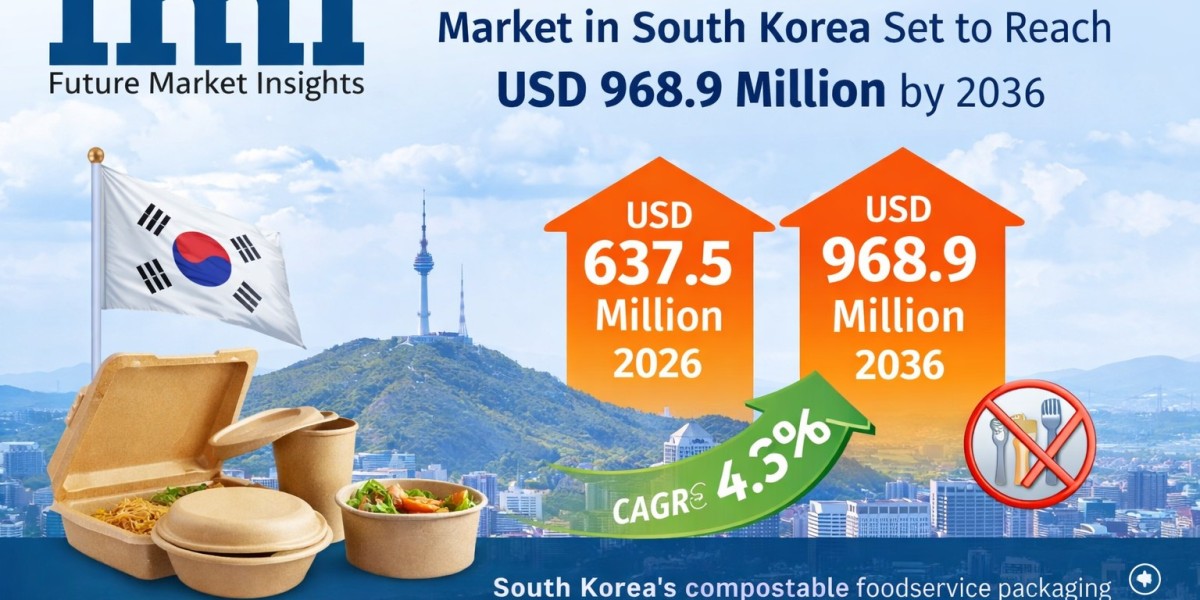

The South Korea compostable foodservice packaging market is experiencing steady growth as regulatory pressure and consumer environmental awareness reshape the nation’s food delivery and restaurant ecosystem. The market is projected to reach USD 637.5 million in 2026 and is forecast to expand to USD 968.9 million by 2036, reflecting a compound annual growth rate (CAGR) of 4.3% during the forecast period.
Quick Stats: Compostable Foodservice Packaging Market in South Korea (2026–2036)
• Market Value (2026): USD 637.5 Million
• Forecast Value (2036): USD 968.9 Million
• CAGR: 4.3%
• Leading Segment: Paper & Paperboard (38.0% Share)
• Key Product Segment: Plates (38.3% Share)
• Fastest-Growing Regions: Jeju, South Gyeongsang, South Jeolla, North Jeolla
• Key Growth Driver: Government regulations targeting plastic waste reduction
Structural Growth Driver: Plastic Waste Reduction Policies and Circular Economy Initiatives
Government regulation is the most significant structural driver shaping the compostable foodservice packaging market in South Korea. Authorities are enforcing strict waste management policies designed to reduce reliance on petroleum-based plastics and encourage adoption of sustainable materials across the foodservice sector.
Key regulatory and industry standards shaping the market include:
• Plastic waste reduction regulations
• Extended producer responsibility policies
• Compostability certification requirements
• Sustainable material sourcing guidelines
• Corporate ESG procurement standards
From Compliance to Industry Transformation
South Korea’s foodservice sector is transitioning from regulatory compliance to broader sustainability transformation. Restaurant chains, cafes, and delivery platforms are increasingly integrating compostable packaging solutions into their operational models to reduce environmental impact and meet evolving consumer expectations.
Companies in the sector are prioritizing:
• Sustainability performance and carbon reduction
• Cost efficiency through scalable material production
• Recyclability and compostability
• Operational compatibility with food delivery logistics
• Compliance with evolving environmental regulations
Technology Transformation: Bio-Based Materials and Marine Biomass Innovation
Technological innovation is playing an increasingly important role in expanding the capabilities of compostable packaging materials. South Korean researchers and manufacturers are exploring new feedstocks such as algae, seaweed, and agricultural residues to develop next-generation biodegradable packaging materials.
The industry is witnessing rapid innovation across multiple areas:
• Advanced bio-based polymer development
• Marine biomass materials such as algae and seaweed
• Lightweight fiber-based packaging structures
• Sustainable material engineering for food safety
• Manufacturing efficiency improvements in molded-fiber production
Segment Highlights
By Material Type
• Paper & Paperboard (38.0% Share): Dominant material due to strong recycling infrastructure and consumer familiarity with paper waste separation.
• Plastic (Biopolymers): Compostable plastics such as PLA and PHA are gaining traction in delivery containers and transparent packaging.
• Bagasse & Seaweed (24.0% Share): Agricultural byproducts provide strong insulation and structural rigidity for hot food containers.
• Others: Includes bamboo fiber and specialty biodegradable materials used in niche packaging applications.
By Packaging Type
• Plates (38.3% Share): Widely used for outdoor dining, festivals, and takeaway meals.
• Trays: Commonly used for ready meals and multi-compartment food packaging.
• Bowls: Essential for soups, noodles, and stews in delivery services.
• Cups: Increasing adoption in cafes due to restrictions on disposable plastic cups.
• Clamshell Containers: Popular for burgers, fried foods, and takeaway meals.
Regional Outlook: Emerging Regions Drive Sustainable Packaging Adoption
Regional adoption patterns across South Korea vary depending on tourism activity, industrial presence, and environmental policy implementation. Coastal tourist destinations and environmentally sensitive regions are leading the transition toward compostable packaging solutions.
Regional growth is also influenced by local government initiatives promoting waste reduction and sustainable foodservice practices.
Regional growth projections include:
• Jeju (5.1% CAGR): Strong demand driven by the “Plastic-Free Island” policy and tourism-driven sustainability initiatives.
• South Gyeongsang (4.5% CAGR): Industrial catering and corporate ESG policies drive adoption.
• South Jeolla (4.1% CAGR): Agricultural byproducts enable local production of compostable packaging.
• North Jeolla (3.4% CAGR): Food processing clusters adopt sustainable packaging to meet export standards.
• South Korea (4.3% CAGR overall): National regulatory frameworks continue to support market expansion.
Risk Landscape: Market Constraints and Challenges
Despite increasing demand for compostable foodservice packaging, several operational challenges limit full market potential. Infrastructure limitations, particularly in industrial composting facilities, hinder the effective processing of certain biodegradable materials.
Key market risks include:
• Limited industrial composting infrastructure
• High cost of bio-based materials
• Supply chain dependency on imported pulp and polymers
• Regulatory compliance complexity
• Limited consumer awareness of composting practices
Competitive Landscape: Key Market Players
The competitive landscape includes global packaging companies expanding production capacity to meet South Korea’s growing demand for sustainable foodservice packaging. Many firms are investing in local manufacturing and R&D partnerships to tailor materials specifically for Korean foodservice applications.
Top key companies include:
• Huhtamaki Oyj
• Stora Enso Oyj
• Georgia-Pacific LLC
• WestRock Company
• Mondi Group
Other notable companies include Reynolds Consumer Products, Genpak LLC, Vegware, Pactiv LLC, and Dart Container Corporation.
Outlook: Future of the Compostable Foodservice Packaging Market in South Korea
The future of the compostable foodservice packaging market in South Korea will be shaped by continued regulatory enforcement, technological innovation in bio-materials, and expansion of sustainable waste management infrastructure.
As food delivery services continue to expand and environmental regulations tighten, compostable packaging solutions are expected to become standard across the country’s restaurant and delivery sectors.
Key future growth drivers include:
• Technology advancement in bio-based packaging materials
• Sustainability initiatives and government waste policies
• Manufacturing expansion for compostable packaging products
• Supply chain innovation in eco-friendly delivery systems
For an in-depth analysis of evolving industry trends and to access the complete strategic outlook for the market through 2036, visit the official report page at:
https://www.futuremarketinsights.com/reports/south-korea-compostable-foodservice-packaging-market