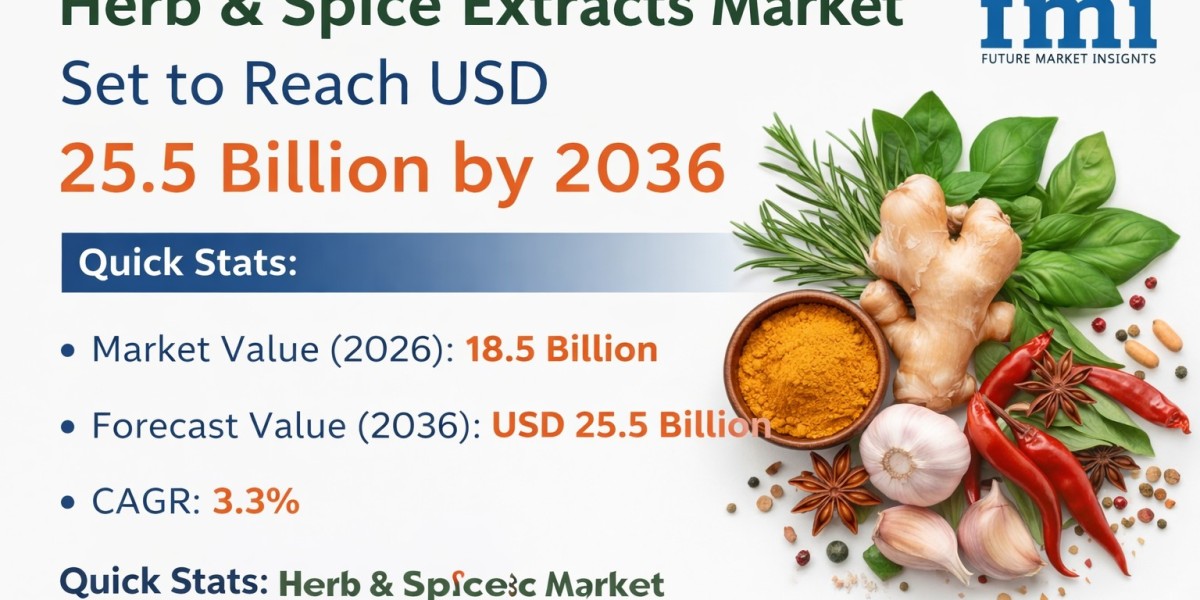

The global herb & spice extracts market is entering a phase of structured, innovation-led expansion, supported by rising clean-label reformulation across food, beverage, nutraceutical, and personal care sectors. Valued at USD 18.5 billion in 2026, the market is projected to reach USD 25.5 billion by 2036, registering a CAGR of 3.3% during the forecast period.
Quick Stats: Herb & Spice Extracts Market (2026–2036)
• Market Value (2026): USD 18.5 Billion
• Forecast Value (2036): USD 25.5 Billion
• CAGR: 3.3%
• Leading End-Use Segment: Food (70% share)
• Largest Product Category: Spices (57% share)
• Leading Form Segment: Powder & Granules (42% share)
• Top Sales Channel: Indirect Sales (64% share)
• Fastest-Growing Country: Japan (3.9% CAGR)
Structural Growth Driver: Clean-Label and Natural Ingredient Reformulation
The primary structural growth catalyst for herb and spice extracts remains the global shift toward natural, minimally processed ingredients. Consumers are increasingly rejecting artificial additives, synthetic preservatives, and flavor enhancers, creating strong tailwinds for botanical extracts across packaged food and beverage categories.
From Flavoring to Functional Value Creation
While flavor enhancement remains foundational, value growth is increasingly concentrated in functional and health-forward positioning.
Botanical extracts are now being incorporated into:
• Functional beverages and RTD teas
• Plant-based and vegan formulations
• Clean-label condiments and sauces
• Skincare and aromatherapy products
• Dietary supplements and traditional medicine
Technology Transformation: Advanced Extraction and Stability Enhancement
The next decade of innovation in herb & spice extracts will be shaped by:
• Supercritical CO₂ extraction for solvent-free purity
• Ultrasonic-assisted extraction for higher yield and potency
• Microencapsulation for flavor retention and shelf-life extension
• Low-heat processing methods preserving bioactive compounds
• Water-based and green extraction systems aligned with ESG mandates
Segment Highlights
By Product Type
• Spices (57% share): Strong demand across global cuisines, clean-label reformulations, and preservation functions.
• Herbs: Growing adoption in wellness beverages and botanical skincare applications.
By End Use
• Food (70% share): Largest demand base, particularly sauces, dressings, condiments, snacks, bakery, and dairy.
• Beverages: Expanding use in RTD tea, juices, and functional drinks.
• Personal Care & Aromatherapy: Rising application of essential extracts in skincare and haircare.
By Form
• Powder & Granules (42% share): Preferred for cost efficiency, solubility, and shelf stability.
• Liquid Extracts: Gaining traction in beverages and nutraceutical syrups.
By Sales Channel
• Indirect Sales (64% share): Supermarkets, specialty stores, and store-based retailing dominate.
• Online Retail: Fastest-growing sub-channel, particularly among health-conscious consumers.
By Nature
• Conventional (58% share): Dominates due to affordability and scalable supply chains.
• Organic & Non-GMO: Expanding in premium segments.
Regional Outlook: East Asia Leads Incremental Growth
Asia-Pacific is projected to deliver steady incremental growth, supported by biodiversity resources and traditional herbal consumption patterns.
Country-level CAGR projections:
• Japan (3.9% CAGR): Functional beverages, herbal supplements, and botanical skincare demand rising.
• Germany (3.8% CAGR): Premium organic and sustainably sourced extracts.
• United States (3.7% CAGR): Strong clean-label reformulation and ethnic cuisine growth.
• United Kingdom (3.6% CAGR): Plant-based food expansion supporting botanical ingredient uptake.
• France (3.5% CAGR): Culinary heritage and aromatherapy applications driving steady growth.
Risk Landscape: Supply Chain and Cost Pressures
Despite stable growth fundamentals, the market faces structural challenges:
• Climate sensitivity affecting raw herb and spice availability
• Geopolitical disruptions impacting sourcing regions
• Higher costs for organic and specialty-certified extracts
• Regulatory inconsistencies across international markets
• Margin pressure in price-sensitive emerging economies
Competitive Landscape: Innovation and Portfolio Depth Define Leadership
The herb & spice extracts market remains moderately consolidated, with global leaders maintaining competitive advantage through scale, R&D, and distribution reach.
Key players include:
• Givaudan S.A.
• Kerry Group Plc.
• McCormick & Company, Inc.
• Sensient Technologies Corporation
• Firmenich SA
• Symrise AG
Strategic focus areas include:
• Sustainable sourcing partnerships
• Clean-label certifications
• Premium botanical blends
• Functional and wellness-oriented ingredient systems
• Expansion in Asia-Pacific distribution networks
Outlook: Botanical Extracts Become Core to Clean-Label Reformulation Strategy
By 2036, herb and spice extracts are expected to evolve from being primarily flavoring agents to becoming strategic formulation platforms spanning:
• Natural flavor enhancement
• Functional nutrition and wellness applications
• Clean-label preservation systems
• Botanical personal care solutions
• Premium plant-based innovation
For an in-depth analysis of evolving formulation trends and to access the complete strategic outlook for the Market through, visit the official report page at: https://www.futuremarketinsights.com/reports/herb-and-spice-extracts-market