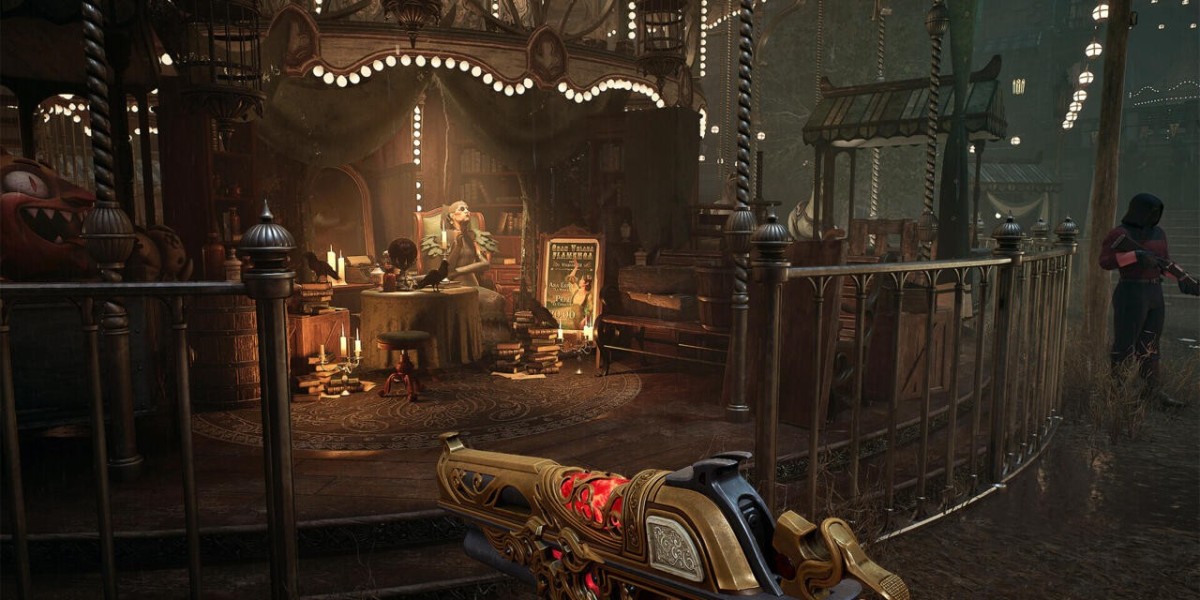

The best thing Crisol: Theater of Idols has going for it is the world it is set in. The game clearly takes many cues from the likes of Resident Evil and BioShock in terms of cultivating a sense of mystique and atmosphere in its opening hour, with tension-building sound design, closed-off environments, and unnerving enemies that are visually human-like but move in an unnatural manner. Unlike those games, however, Crisol begins to lose its edge when the enemies become too numerous and easy to defeat, undermining the sense of danger that first built up its setting and undercutting the game's best mechanic. The first-person shooter gameplay grows increasingly dull as the layouts of different arenas become repetitive, keeping combat from evolving in exciting ways. And while the narrative framework of Crisol is interesting and immediately draws you in, the actual story is held back by another drag: its protagonist.
In Crisol: Theater of Idols, you play as Gabriel, a soldier of the god of the sun who has infiltrated the perpetually stormy island settlement of Tormentosa, a locale that is part of Hispania, a nightmarish version of Spain. Gabriel is waging war against the sea god for his master and receives his mission instructions through visions that the sun god sends him. He must make his way across the island, working alongside the remnants of a human resistance that is struggling to survive against statues that have been given some form of sentience and now move with murderous purpose. Throughout it all, he is dragged further and further into the history and politics of the ongoing war between the two deities.
The best part of Crisol is its blood-for-bullets mechanic. There is no ammo in Crisol--instead, you refill each firearm by injecting Gabriel's blood into them. This, obviously, hurts. As a result, Gabriel's health and firearm ammo both pull from the same resource bar. This is not too much of an issue on the easiest difficulty, but on the harder ones, this blood-for-bullets mechanic makes for an interesting risk-versus-reward gameplay loop. You have to carefully manage how much you reload your firearms.
In any other shooter, I am reloading with every break in combat. Heck, I am reloading every single firearm I have whenever there is even the slightest lull in the action. Not so in Crisol. If my health is running low, it is better to only reload a few firearms, and maybe I only opt to fully reload one. Every weapon in Gabriel's arsenal is flintlock-inspired, so you can decide exactly when to stop reloading, and it can be tense to watch him put one blood bullet in a gun at a time while his health bar slowly ticks down.
Save for the absolutely most brutal difficulty, this blood-for-bullets mechanic never goes so far as to make Crisol feel deserving of its "survival-horror" label, but it definitely feeds into the challenge of the game on all difficulties while encouraging you to scrounge for blood sources. In Crisol, that comes in two forms: vials of blood (which behave like health potions), and blood-filled corpses. The latter is especially interesting, as Gabriel hears a bit of the victims' last moments, whether that's the final squeal of a dying pig or the scared whispers of a man at the end of his rope. It all helps feed into the hopeless nature of the world, and it adds an interesting narrative element to resource-gathering. Tying the hero's health bar to their ammo is one of the coolest mechanics in a shooter that I have seen, amplifying the dread of being at low health or being surrounded by multiple enemies by repeatedly asking whether the strategy is to conserve your hit points or keep the ammo reserves up.
So it is such a shame that this mechanic is wasted on boring gameplay. In terms of combat, Crisol's biggest problem is a lack of enemy variety. There are essentially only two types of enemies in Crisol: living statues that slowly lumber toward Gabriel and try to slash him to bits, and a big, invincible lady that chases after Gabriel through specific moments in the story. There are a few variants (like living statues with guns, or little hovering drones that pepper Gabriel from afar), but you will run into the first two types a lot--especially the former. Crisol increases its challenge by increasing the number of enemies in a combat encounter over time, or adding environmental concerns like motion-sensing explosives, but it is never done in a way that changes how you fight. It only adds to how long you fight. How you get through a level in Crisol three hours in is the same way you do so in the first 30 minutes--there are just more enemies to shoot.
And while you may argue that this should create an escalating rate of challenge--after all, more enemies means more expended bullets, and thus more spent health to reload--it does not. Crisol includes a weapon upgrade system that lets you increase the strength of Gabriel's arsenal at a pretty steady rate, so as the enemies get more plentiful, your weapons do more damage. You are spending fewer bullets on each individual enemy as time goes on--it basically all evens out in the end.
Gabriel is also armed with a knife that can be used in a pinch if enemies get too close or your health bar gets too low. It cannot be thrown, but the knife can also parry melee attacks. And while that is interesting--every game with a parry mechanic gets some coolness points from me--the mechanic isn't necessary and oftentimes feels superfluous. The knife can dull and become useless, forcing you to spend resources to sharpen it again, so I never wanted to use it in case I ever really needed it. As a result, I made it through the game largely without using the knife. Once Gabriel had the shotgun, the knife was forgotten. If anything, the knife feels like something tacked on--it doesn't detract from the game, but it doesn't add anything, either.
While the many, many statues that Gabriel fights go down with a few well-placed shots, the hulking Dolores is an invincible enemy that stalks you through specific moments in the game, similar to Resident Evil 3 Remake's Nemesis. Dealing with Dolores is more annoying than scary as Gabriel lacks any means of distracting or stunning Dolores, so contending with her is a lot of hiding and waiting for her to pass, running to the next hiding spot while she snaps insults at you, and staying alive until she gives up looking for you. The first time, it is pretty tense! But after repeating that pattern, the tension is gone, and the "challenge" of dealing with Dolores becomes one of patience. Dying during these segments is particularly irritating, as the autosave will kick you back to the beginning of the encounter, forcing you to go through the hiding and waiting and running and hiding pattern from the very beginning.
I could have seen beyond the shortcomings in Crisol's combat if the story had been as engaging as the narrative elements that set it up. Gabriel drags the story down a lot, though. He is distrustful of others and quick to anger or insult. He is not likable, and that makes it hard to care about him or his mission.
But at least Gabriel has a personality. The human rebels he aids throughout the game are largely faceless, adorned in masks, and unimportant to the story. The one exception is their leader, and she's a completely different kind of annoying--overly bubbly and childlike in a way that can quickly get under your skin with her incessant walkie-talkie chats. These regularly break the tension and keep the experience of playing Crisol from fully embracing the sense of fear and unease that it built up so well in the first 60 minutes. I spent so much of Crisol wondering who I was supposed to care about and why, and the game never answered those questions.
It's such a shame, because Crisol has really cool lore, and a setting not often capitalized in horror-action shooters--especially visually, with the Spanish-inspired architecture twisting into something darker and almost gothic. This world is gorgeous and yet hauntingly empty. It's the kind of world where you can look around and see evidence of life, and immediately understand where you are within the framework of the community--a carnival, a market, a car mechanic. It feels like a place that is lived-in and a part of a greater and grander world. We just happen to be seeing it at its darkest, when so many have died, and those that remain are clinging to what culture they can.
The history and lore of the sun and sea gods is the best part of that world, and as you unravel the origins of the conflict between them and better understand just how fraught a situation you are in, the game pulls you in. I was so invested in uncovering what exactly happened and wanted to learn how it all went wrong--this is one of those games where I wish there were hundreds of text logs to parse through.
I wanted to like Crisol: Theater of Idols so badly. The atmosphere of the shooter is delightfully spooky, and the Spanish influences make for a narrative backdrop and lore that you want to sink your teeth into. But too often, Crisol is held back by its gameplay. The blood-for-bullets mechanic adds some fun strategic depth, but the overall experience is held back by repetitive enemy design and arena layouts. Better single-player first-person shooters can be found elsewhere.