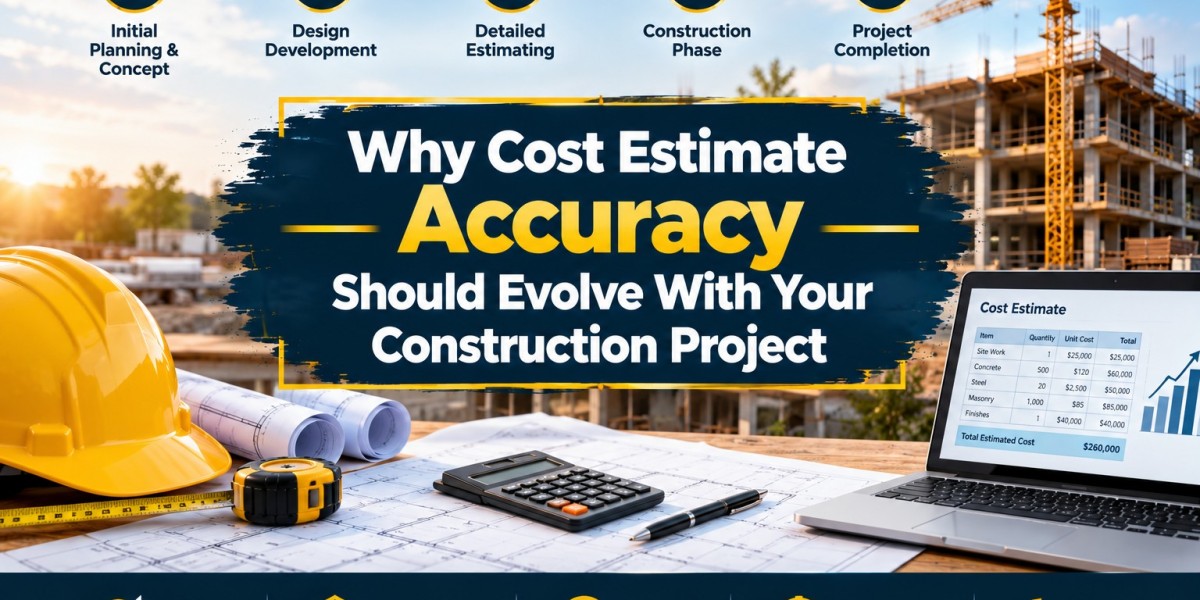

Every construction project starts with a number. Unfortunately, that first number is rarely the number the project ends up costing. Owners, developers, and contractors often get frustrated when early budgets and final costs don't match but the truth is, they were never supposed to match. Early estimates and final estimates serve different purposes, and understanding that difference is one of the most overlooked skills in project planning.
Why a Single Estimate Is Never Enough
Think about how much information you actually have on day one of a project. You might know the general square footage, the rough location, and maybe a concept sketch. You almost certainly don't know the final finishes, the subcontractor pricing, or the exact engineering specs. Trying to produce a bank-grade, penny-accurate estimate at this stage would be a waste of time and money; the information simply doesn't exist yet.
That's why experienced estimators don't rely on one estimate. They build a series of estimates, each one sharper than the last, as the design develops and more details become available. This progression is often organized into a structured framework, and one of the clearest breakdowns of that process comes from SMA Estimating's guide to the six levels of construction cost estimates, which walks through how estimates move from a rough order of magnitude all the way to a locked-in construction budget.
The Cost of Getting This Wrong
Skipping levels or treating a preliminary number as a final one is one of the most common and most expensive mistakes in construction planning. If an owner treats a rough order-of-magnitude figure as gospel and locks in financing around it, any gap between that number and the eventual bid estimate can derail the entire project. On the flip side, contractors who wait too long to estimate anything risk losing bids to competitors who priced the job earlier and more strategically.
How Estimate Accuracy Builds Over Time
Construction cost estimating isn't a single event; it's a process that tightens as risk decreases. Here's the general logic behind why accuracy improves at each stage:
Early Stage: Speed Over Precision
At the earliest point in a project, the goal isn't precision, it's speed and directional accuracy. Owners need a ballpark figure to decide whether a project is even worth pursuing. Estimators lean on historical data, comparable projects, and industry benchmarks rather than detailed drawings.
Mid Stage: Design Drives the Numbers
As architectural and engineering drawings take shape, estimates start reflecting actual site conditions, material choices, and system designs. This is where conceptual and definitive-style estimates come in, translating design intent into dollar figures that are far more reliable than the early guesses.
Final Stage: Market Reality Sets the Price
By the time subcontractor bids come in, the estimate stops being a projection and starts being a reflection of real market pricing. This is the stage where numbers firm up into the figures that actually get written into contracts and construction budgets.
Understanding this progression and knowing which stage of estimate you're actually looking at is exactly what SMA Estimating's breakdown of the six levels of construction cost estimates is built to explain in more detail.
Practical Tips for Managing Estimates Across a Project
Match the Estimate to the Decision You're Making
Don't ask for bid-level precision when you're still deciding whether to buy the land. Match the level of detail in your estimate to the level of decision you're actually trying to make.
Revisit Your Budget at Every Design Milestone
Every time a design milestone is reached schematic design, design development, construction documents it's worth revisiting the cost estimate. Costs that seemed reasonable at 30% design completion can shift significantly by 90%.
Build in Contingency, Especially Early On
The less design information you have, the more contingency you should carry in your budget. As the project matures and uncertainty shrinks, that contingency can shrink too.
Involve Estimators Early, Not Just at Bid Time
Bringing a professional estimator in during early planning rather than only at the bidding stage gives owners and contractors a much more realistic financial roadmap from day one.
Final Thoughts
Construction budgets don't fail because estimators are bad at their jobs. They fail because people misunderstand what stage of estimation they're actually looking at, and treat an early number with the same confidence as a final one. Recognizing that cost estimating is a progression not a one-time calculation is the difference between a project that stays on budget and one that runs into painful surprises down the road.
For a more detailed, stage-by-stage breakdown of how this process works in practice, SMA Estimating's article on the six levels of construction cost estimates is a solid resource for owners, contractors, and project managers alike who want to plan their budgets with more confidence and fewer surprises.