
Introduction
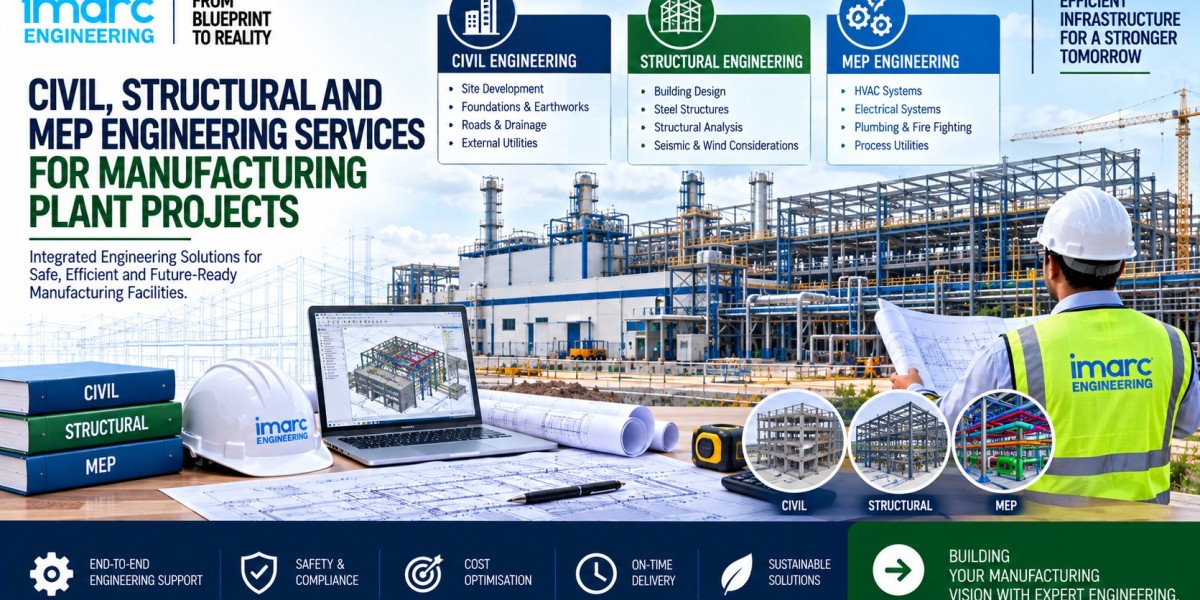
Civil, structural and MEP engineering services shape the physical backbone of a manufacturing plant. Civil and structural work defines foundations, buildings, roads and drainage. MEP—mechanical, electrical and plumbing—covers power distribution, lighting, HVAC, water systems, fire protection and related building services.
When these packages are designed in isolation from process needs, projects face interface clashes, rework, delayed commissioning and operating constraints. When coordinated early with layout, equipment loads and utility demand, plants become safer to build and easier to run. Civil, Structural and MEP Engineering Services for Manufacturing Plant Projects help align these design requirements with plant execution and operational needs.
IMARC Engineering supports manufacturers with plant engineering advisory, layout planning and industrial project support across India.
Why Civil, Structural and MEP Coordination Matters
India’s manufacturing sector continues to attract capacity investment under policy support and industrial expansion.
- Manufacturing growth is estimated at around 7% at constant prices in FY 2025-26 (MoSPI First Advance Estimates).
- FDI into manufacturing rose 18% in FY 2024-25 to US$19.04 billion (Ministry of Commerce & Industry / DPIIT).
- PLI cumulative investment has exceeded ₹2.16 lakh crore, with cumulative production and sales surpassing ₹20.41 lakh crore as of December 2025 (PIB).
- Logistics costs have improved to an estimated 7.97% of GDP (DPIIT-NCAER study).
As more greenfield plants and brownfield expansions move into design, civil, structural and MEP quality becomes a direct driver of constructability, installed cost and operating reliability.
What These Engineering Services Cover
Civil engineering
Site grading, roads, paving, drainage, underground services corridors and external works that support plant logistics and storm management.
Structural engineering
Building frames, equipment foundations, platforms, pipe racks, supports and load-bearing systems matched to process and equipment requirements.
MEP engineering
Electrical distribution, lighting, earthing, HVAC, plumbing, fire-fighting systems, compressed air distribution where part of building services, and related controls that keep the facility operable and compliant.
For manufacturing plants, these are not generic building services. They must respond to equipment loads, process utilities, clean or hazardous area needs, maintenance access and future expansion.
Why Manufacturing Plants Need Integrated Design
Process equipment creates dynamic loads, vibration sensitivity, heavy floor loadings and continuous interface with power, water, drainage and HVAC. Civil and structural grids must allow installation and maintenance access. MEP systems must match demand profiles, redundancy needs and statutory requirements.
If structural openings, cable routes, drain points and equipment pads are finalised late, site teams compensate with costly variations. Integrated design reduces that risk.
Key Planning Inputs Before Design Starts
Define early:
- Process layout and equipment load profile
- Building use, span needs and maintenance access
- Geotechnical investigation status and soil constraints
- Power, water, HVAC and fire-load requirements
- Utility corridor and underground services intent
- Road, drainage and fire-tender access requirements
- Future expansion zones and structural or MEP provisions
- Brownfield constraints, if work is inside a live plant
Clear inputs are the first control point for civil, structural and MEP quality.
Greenfield and Brownfield Differences
Greenfield projects allow cleaner structural grids and MEP routing, but only if process and equipment data stabilise early. Late equipment changes can force foundation, cable tray and HVAC revisions.
Brownfield projects are more constrained. Existing structures, live utilities, restricted access and shutdown windows limit options. Design must plan phased works, temporary arrangements and tie-ins without disrupting current operations.
How to Evaluate Civil, Structural and MEP Partners
1. Check industrial experience
Look for manufacturing or process-plant projects with similar load intensity and utility interfaces, not only commercial building work.
2. Evaluate interface capability
Ask how the firm manages load data, clash review, revision control and coordination across civil, structural, MEP and process packages.
3. Assess constructability thinking
Designs should be buildable with practical methods, maintainable in operation and accessible for installation.
4. Review foundation and geotechnical discipline
Confirm soil investigation, settlement criteria and equipment foundation requirements are handled before critical designs are frozen.
5. Confirm MEP demand and redundancy logic
Power, HVAC and water systems should reflect real operating loads, not generic building norms alone.
6. Clarify construction-stage support
Industrial projects need query support and site coordination during foundation, structural and MEP installation.
Common Mistakes in Plant Engineering Packages
- Freezing structural grids before equipment data is stable
- Designing MEP from architectural templates without process load input
- Separating civil drainage from utility and road planning
- Ignoring brownfield access and shutdown constraints
- Weak clash detection between structure, cable trays and process piping
- Treating drawing issue as the end of engineering support
How IMARC Engineering Supports Civil, Structural and MEP Project Decisions
IMARC Engineering works with manufacturers and project developers who need plant engineering decisions aligned with process, cost and execution reality.
- Project planning and layout coordination inputs
- Infrastructure and constructability-focused advisory
- CapEx-aware design thinking for greenfield and brownfield facilities
- Advisory across pharmaceuticals, food and beverage, chemicals, auto components, electronics, FMCG and discrete manufacturing
Contact IMARC Engineering’s team for manufacturing plant engineering and project advisory support across India: https://www.imarcengineering.com/contact?service=civil-structural-mep-design-and-validation
Conclusion
Civil, structural and MEP engineering services for manufacturing plant projects succeed when foundations, buildings and building services are designed around process loads, constructability and operating needs. In a manufacturing economy supported by PLI investment, rising FDI and continued capacity creation, plant projects depend on engineering partners who understand both structure and industrial reality.
Integrated design protects cost, schedule and long-term operability. Fragmented packages often show up later as rework, delay and constrained plant performance—when options are fewer and correction is expensive.
Through plant engineering and project advisory support, IMARC Engineering helps manufacturers make civil, structural and MEP decisions that hold up from design through execution.
Contact Us:
IMARC Engineering
Phone: +91-120-433-0800
Email: sales@imarcengineering.com
India: C-130, Sector 2, Noida, Uttar Pradesh 201301
LinkedIn: https://www.linkedin.com/showcase/imarc-engineering/