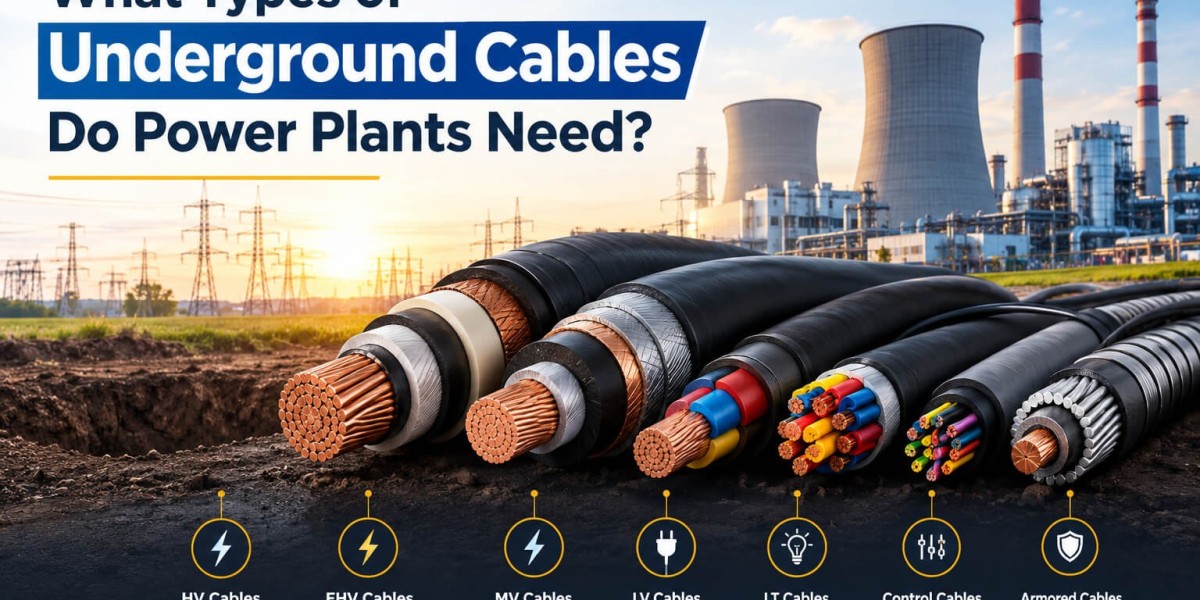

When a new power plant project was being planned near Lahore, the electrical team had one major question before laying the underground network: “Which cables should go where?” The plant needed cables for high power transmission, local distribution, equipment control, and mechanical protection. Using one cable type everywhere was clearly not the right answer.
Power plants in Pakistan need different underground cables for different electrical duties. HV and EHV cables, MV cables, LV cables, control cables, and armored protection cables each have a specific role. The right selection depends on voltage, current, insulation, installation conditions, fault levels, and the equipment being connected.
Why Do Power Plants Need Different Underground Cables?
A power plant has several electrical systems working together. Electricity generated at the plant may travel through high-voltage networks, while transformers reduce voltage for medium-voltage distribution and lower-voltage systems.
At the same time, control rooms, motors, pumps, protection systems, sensors, and auxiliary equipment need their own electrical connections.
Using the correct cable for each section helps maintain safe operation, reduce power losses, and support reliable electricity distribution.
What Are HV and EHV Cables Used For?
High-voltage cables, also called HT cables, carry large amounts of electrical power at high voltage levels. Extra high voltage, or EHV cables, are designed for even higher transmission voltages.
In a power plant, these cables may connect generators with transformers, substations, or high-voltage transmission equipment.
Design and Insulation
HV and EHV cables need strong insulation because the electrical stress is much higher than in ordinary electrical wires. Common insulation systems use XLPE, supported with suitable conductor screens, insulation screens, metallic screens, and protective outer layers.
Copper and aluminium conductors can be used depending on the project requirements.
Where Are They Used?
HV and EHV cables are suitable for:
- Generator and transformer connections
- Substation connections
- High-voltage power transmission
- Underground grid connections
- Large industrial power networks
For underground installation, engineers also assess thermal conditions, soil characteristics, cable spacing, fault current, and installation depth.
Why Are MV Cables Important in Power Plants?
Medium voltage cables, commonly called MV cables, handle power distribution after voltage has been reduced through transformers. They form an important part of internal power distribution systems.
Typical MV systems operate above 1 kV and can extend into the tens of kilovolts, depending on the electrical network and applicable standards.
Design and Insulation
MV cables commonly use copper or aluminium conductors with XLPE insulation. Metallic screens and suitable outer sheaths help manage electrical stress and protect the cable construction.
These cables may connect transformers, switchgear, distribution panels, motors, and other plant equipment.
For many power plants in Pakistan, MV cables are an important link between major electrical equipment and the plant's distribution network.
When Are LV and LT Cables Required?
LV cables and LT cables are used for lower voltage systems. They normally serve auxiliary electrical loads rather than the main high-voltage transmission path.
Power plants have many smaller electrical systems, so these cables can be found throughout the facility.
Common Applications
LV and LT cables may supply:
- Lighting systems
- Small motors
- Pumps
- HVAC equipment
- Auxiliary panels
- Building services
- General electrical equipment
PVC and XLPE are common insulation choices, depending on voltage rating, temperature, installation conditions, and project specifications.
What Role Do Control Cables Play?
Power plants do not only move electricity. They also need to monitor and control equipment. This is where control cables become important.
Control cables carry electrical signals between control panels, switchgear, relays, motors, protection systems, and automation equipment.
They normally operate at much lower voltage than power cables. Their design may use multiple cores, so several control signals can travel through one cable.
Important Design Features
Control cables can be designed with:
- Multiple copper cores
- PVC or XLPE insulation
- Individual core identification
- Inner and outer sheaths
- Shielding where signal protection is required
- Armouring where mechanical protection is needed
Correct cable selection helps reduce unwanted electrical interference and keeps control signals accurate.
Why Are Armoured Protection Cables Useful Underground?
Underground cables can face physical pressure during installation and operation. Construction activity, soil movement, moisture, and accidental impact can damage an exposed cable.
Armoured cables add a mechanical protection layer around the cable construction.
The armour can be made from steel wire, steel tape, or another suitable material depending on the cable design and application.
Where Can Armoured Cables Be Used?
They are useful for:
- Underground power circuits
- Industrial areas
- Cable trenches
- Plant distribution networks
- Areas where mechanical protection is required
The armour also needs proper earthing and termination according to the cable design and electrical installation requirements.
Which Underground Cable Should a Power Plant Choose?
Cable Type | Main Voltage Range | Main Purpose | Common Insulation |
HV and EHV | High and extra high voltage | Main power transmission | XLPE |
MV | Above 1 kV to medium voltage levels | Plant distribution | XLPE |
LV and LT | Low voltage | Auxiliary systems | PVC or XLPE |
Control | Low control voltages | Signals and equipment control | PVC or XLPE |
Armored | Depends on cable type | Mechanical protection | PVC or XLPE with armour |
The best choice depends on the complete electrical design. Engineers should check voltage rating, conductor size, current capacity, short-circuit rating, insulation, installation method, temperature, cable length, and environmental conditions before selecting a cable.
What Should Power Plants Look For in Cables in Pakistan?
When selecting the best electrical cables in Pakistan, power plant operators should look beyond the cable's size or price. A cable must match the electrical load and installation environment.
Copper cables offer high conductivity and are widely used where their electrical and physical properties suit the project. Aluminium conductors can also be suitable for certain large power applications where lower weight is useful.
For underground installations, the cable's insulation, sheath, armour, water resistance, thermal performance, and fault withstand capability should also match the project requirements.
Why Choose Universal Cables Industries Ltd.?
Universal Cables Industries Ltd. is one of the leading electric cables manufacturers in Pakistan, with experience across different electrical cable requirements. The company is known for Pakistan's premium-selling copper cables since 1978, serving electrical and industrial applications.
For power plants looking for the best cables in Pakistan, cable selection should still match the voltage level, load, installation conditions, and technical specifications of each project. Universal Cables Industries Ltd. offers cable solutions suited to different electrical applications.
Final Thoughts: Match the Cable With the Job
A power plant needs more than one type of underground cable. HT cables and high-voltage cables handle major power transmission, MV cables support internal distribution, LV and LT cables serve auxiliary loads, while control cables handle signals and equipment operation. Armouring adds mechanical protection where the installation needs it.
The safest approach is to select each cable according to its electrical duty, insulation system, environment, and installation method. For major power projects in Pakistan, qualified electrical engineers should review the complete cable design before installation.
FAQs
What cables are commonly used in power plants?
HV, EHV, MV, LV, LT, control, and armoured cables are used for different plant systems.
What insulation is common for MV cables?
XLPE is widely used for medium-voltage cable insulation.
Are copper cables suitable for power plants?
Yes. Copper cables are widely used where their conductivity and physical properties suit the electrical design.
Why are control cables needed?
They carry signals between control systems, equipment, protection devices, and panels.
Why use armoured underground cables?
Armour adds mechanical protection against physical forces that may affect underground cable installations.
Disclaimer: This article is for general educational purposes. Power plant cable selection, installation, testing, termination, and earthing should follow applicable standards and project requirements and should be handled by qualified electrical professionals.