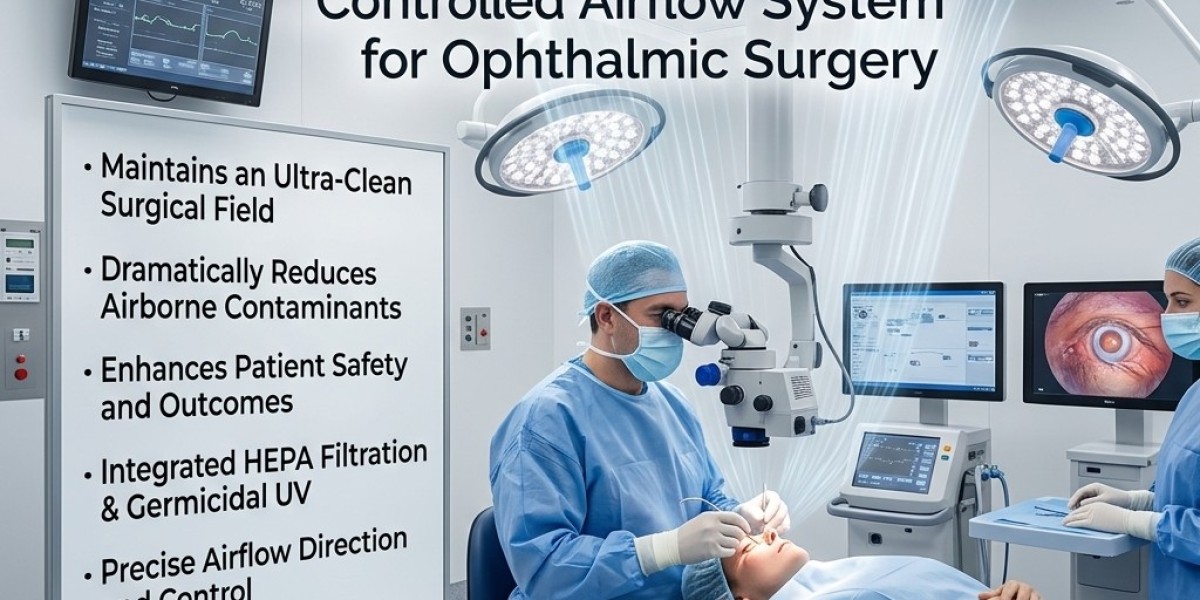

Laminar Airflow Improve Air Quality in an Ophthalmic Modular Operation Theatre?
Air quality is one of the most important factors in modern surgical environments, particularly in an Ophthalmic Modular Operation Theatre, where delicate eye procedures require controlled and hygienic conditions. Laminar airflow systems are designed to provide a controlled flow of highly filtered air across the surgical area, helping reduce airborne particles and maintain a cleaner operating environment. When properly engineered with HVAC systems, HEPA filtration, pressure control, and appropriate airflow distribution, laminar airflow can support effective contamination control and improve environmental consistency inside the theatre.
What Is Laminar Airflow?
Laminar airflow refers to a controlled airflow pattern in which filtered air moves in a relatively uniform direction with minimal turbulence. In an operation theatre, the objective is to reduce the accumulation and uncontrolled movement of airborne contaminants around the critical surgical zone.
The system generally consists of:
- HEPA filtration
- Air handling equipment
- Supply air plenums
- Diffusers or terminal filtration units
- Return or exhaust air pathways
- Airflow control components
- Pressure monitoring systems
The exact configuration depends on the theatre design, surgical requirements, room dimensions, HVAC strategy, and applicable engineering standards.
Why Is Air Quality Important in Ophthalmic Surgery?
Ophthalmic surgeries involve delicate tissues and highly precise procedures. Maintaining a controlled operating environment is therefore an important part of infection prevention and surgical facility design.
Poorly controlled air can contain:
- Dust particles
- Skin flakes
- Microorganisms attached to airborne particles
- Fibres
- Aerosols
- Other environmental contaminants
Personnel movement, doors opening, equipment operation, and uncontrolled ventilation can influence airborne particle levels. A properly designed airflow system helps manage these environmental factors.
A clean surgical environment does not depend on airflow alone. Surface hygiene, sterilization practices, staff protocols, equipment cleaning, room pressure, temperature, humidity, and appropriate HVAC operation also contribute to overall infection-control performance.
How Does Laminar Airflow Improve Air Quality?
Laminar airflow improves air quality primarily by controlling how filtered air enters and moves through the surgical environment.
1. High-Efficiency Air Filtration
One of the most important components is HEPA filtration. HEPA filters are designed to remove a high proportion of airborne particles from the air passing through them.
In a properly engineered system, air is filtered before entering the critical operating area. This helps reduce the concentration of airborne particulate matter and supports a cleaner room environment.
The performance of the filtration system depends on:
- Filter efficiency
- Correct filter installation
- Airflow volume
- Filter integrity
- Housing design
- Sealing
- Maintenance
Therefore, selecting a high-quality filter is only one part of effective air-quality management.
2. Controlled Airflow Direction
Laminar airflow establishes a predictable movement of filtered air.
Depending on the system design, air may be supplied vertically from above the surgical zone or through another carefully engineered configuration. The purpose is to reduce uncontrolled mixing and help move contaminants away from the critical area.
Controlled airflow direction can provide greater consistency than ordinary room ventilation, particularly when the system is correctly balanced.
3. Reduction of Airborne Particles
People naturally release particles into the surrounding environment through skin shedding, movement, clothing, and other activities.
Laminar airflow helps manage these particles by continuously introducing filtered air and directing room air toward designated return or exhaust locations.
This can help reduce airborne particle concentration around the critical surgical zone.
However, laminar airflow should not be considered a substitute for surgical asepsis or proper infection-control procedures.
4. Better Contamination Control
The primary objective of a controlled OT airflow system is contamination management.
A properly designed system combines:
- HEPA filtration
- Controlled airflow
- Positive room pressure
- Suitable air-change rates
- Appropriate return-air positioning
- Sealed room construction
- Environmental monitoring
Together, these features help reduce the opportunity for contaminants from adjacent areas to enter the theatre.
5. Positive Pressure Management
An ophthalmic operating theatre is generally designed to maintain positive pressure relative to surrounding less-clean areas.
Positive pressure means that air tends to move outward when doors or other openings are present rather than allowing uncontrolled air from adjacent spaces to enter.
The pressure relationship should be designed and verified according to the applicable healthcare engineering requirements and project specifications.
Pressure monitoring can help identify:
- Loss of pressure differential
- Door-related airflow problems
- HVAC imbalance
- Filter loading
- System performance issues
6. Improved Environmental Consistency
Air quality is not only about filtration. Temperature and humidity also influence the operating environment.
An integrated HVAC system can help maintain appropriate:
- Temperature
- Relative humidity
- Fresh-air supply
- Air-change rate
- Pressure differential
- Air distribution
Consistent environmental conditions can make the theatre more comfortable for surgical teams while supporting controlled facility operation.
7. Reduced Airborne Contamination in the Critical Zone
The surgical field requires particular attention because it is the area where clinical procedures take place.
A correctly positioned laminar airflow system can provide a cleaner airflow zone around critical surgical equipment and the patient.
The effectiveness depends heavily on the system's design. Incorrect diffuser positioning, excessive turbulence, poor return-air placement, or obstruction from surgical equipment can reduce the expected benefit.
Therefore, airflow modelling and engineering evaluation are important during the planning stage.
Role of HEPA Filters in Laminar Airflow Systems
HEPA filtration is central to most healthcare laminar airflow applications.
Before filtered air reaches the operating area, the system typically passes air through filtration stages designed to protect the final HEPA filter and improve overall air-handling performance.
Pre-filtration can help capture larger particles and protect downstream filtration equipment.
The final HEPA stage provides high-efficiency particle filtration before air enters the controlled area.
For reliable performance, the system should also consider:
- Filter housing integrity
- Gasket or gel sealing
- Air leakage prevention
- Filter accessibility
- Differential pressure monitoring
- Filter replacement procedures
- Integrity testing
Importance of Airflow Velocity
Airflow velocity must be carefully selected during engineering.
Excessively high airflow may create turbulence and discomfort, while insufficient airflow may fail to provide the intended environmental control.
The design should therefore consider:
- Room size
- Ceiling height
- Surgical table location
- Operating microscope position
- Surgical lights
- Medical equipment
- Staff movement
- Air-return locations
The final airflow pattern should be verified after installation rather than relying only on theoretical calculations.
How Does Modular Construction Support Air Quality?
A modular OT uses purpose-designed wall and ceiling systems that can help create a controlled and hygienic enclosure.
Common construction features may include:
- Smooth wall surfaces
- Sealed joints
- Hygienic finishes
- Flush installations
- Hermetically sealed doors
- Cleanable surfaces
- Integrated service systems
Reducing unnecessary ledges, gaps, exposed joints, and difficult-to-clean surfaces can simplify cleaning and support contamination-control practices.
The modular approach also allows HVAC, medical gases, electrical systems, lighting, and other services to be coordinated during the design stage.
Importance of Air Distribution Design
Installing a laminar airflow unit alone does not guarantee effective air quality.
Air distribution should be designed according to the complete room environment.
Engineers need to consider:
- Supply-air location
- Return-air location
- Room geometry
- Equipment arrangement
- Airflow obstacles
- Door locations
- Personnel movement
- HVAC capacity
Poorly positioned equipment can interfere with airflow and create turbulence. This is why the surgical layout and airflow design should be developed together.
Environmental Monitoring and Validation
Validation is an essential stage of an OT project.
After installation, testing may include:
- HEPA filter integrity testing
- Airflow velocity measurement
- Air-change verification
- Particle counting
- Pressure differential testing
- Temperature measurement
- Relative humidity measurement
- HVAC performance verification
These tests help determine whether the installed system performs according to its design specifications.
Regular monitoring is also important because airflow performance can change over time due to filter loading, equipment modifications, maintenance issues, or HVAC imbalance.
Maintenance of Laminar Airflow Systems
Routine maintenance is essential for maintaining consistent air quality.
Maintenance activities can include:
- Filter inspection
- HEPA filter replacement when required
- Airflow balancing
- AHU servicing
- Pressure monitoring
- Diffuser inspection
- Sensor calibration
- Leakage checks
- Periodic validation
Hospitals should maintain proper records of testing and servicing so that changes in environmental performance can be identified early.
Common Factors That Can Reduce Laminar Airflow Performance
Even a well-designed system can lose effectiveness if it is poorly operated or maintained.
Common problems include:
- Blocked air pathways
- Incorrect filter installation
- Damaged filter seals
- Poor room pressure control
- Excessive door opening
- Improper equipment placement
- Unbalanced HVAC systems
- Inadequate maintenance
- Unplanned room modifications
Operational discipline is therefore just as important as technical design.
Benefits of Laminar Airflow in Ophthalmic Operation Theatres
A professionally engineered laminar airflow system can provide several benefits:
- Improved airborne particle control
- Better filtration performance
- Controlled airflow direction
- More stable room conditions
- Support for infection-control strategies
- Improved environmental consistency
- Better integration with HVAC systems
- Easier performance monitoring
- Enhanced surgical-environment management
The benefits depend on correct design, installation, validation, operation, and maintenance.
Future Trends in Ophthalmic OT Air Quality Management
Modern healthcare facilities are increasingly adopting intelligent environmental monitoring technologies.
Future-focused systems may incorporate:
- Digital pressure monitoring
- Smart HVAC controls
- Real-time environmental dashboards
- Automated alarm systems
- IoT-enabled sensors
- Predictive filter maintenance
- Energy-efficient air-handling systems
These technologies can help facility managers identify changes in environmental conditions and respond more quickly to potential system problems.
Conclusion
Laminar airflow improves air quality in an Ophthalmic Modular Operation Theatre by combining high-efficiency filtration with controlled airflow direction, pressure management, HVAC integration, and environmental monitoring. When correctly designed and validated, the system can help reduce airborne particulate contamination and maintain a more controlled surgical environment. However, its performance depends on proper engineering, installation, equipment placement, maintenance, and compliance with appropriate healthcare facility requirements. For hospitals planning reliable modular ophthalmic operation theatres and integrated airflow solutions, Altus Airflow provides specialized engineering and turnkey solutions focused on controlled, efficient, and future-ready healthcare environments.
Frequently Asked Questions
1. How does laminar airflow improve air quality in an Ophthalmic Modular Operation Theatre?
An Ophthalmic Modular Operation Theatre can use laminar airflow to provide controlled, highly filtered air movement over the critical surgical area, helping reduce airborne particles and support contamination control.
2. Why is HEPA filtration important in an Ophthalmic Modular Operation Theatre?
HEPA filtration in an Ophthalmic Modular Operation Theatre helps remove airborne particulate matter from the supply air before it enters the controlled surgical environment, supporting better air cleanliness.
3. Does laminar airflow eliminate all contamination risks in an Ophthalmic Modular Operation Theatre?
No. An Ophthalmic Modular Operation Theatre requires multiple infection-control measures. Laminar airflow supports airborne contamination control but does not replace sterilization, cleaning, staff hygiene, surgical asepsis, and proper operating procedures.
4. How does positive pressure support air quality in an Ophthalmic Modular Operation Theatre?
Positive pressure helps an Ophthalmic Modular Operation Theatre limit uncontrolled entry of air from surrounding areas by maintaining an outward airflow tendency through openings such as doors.
5. What tests are performed on airflow systems in an Ophthalmic Modular Operation Theatre?
An Ophthalmic Modular Operation Theatre may undergo HEPA integrity testing, airflow velocity measurement, particle counting, air-change verification, pressure differential testing, temperature and humidity checks, and HVAC performance testing.
Read Our Previous Blog------>What type of HEPA filtration is used in a Modular Ophthalmic Operation Theatre?