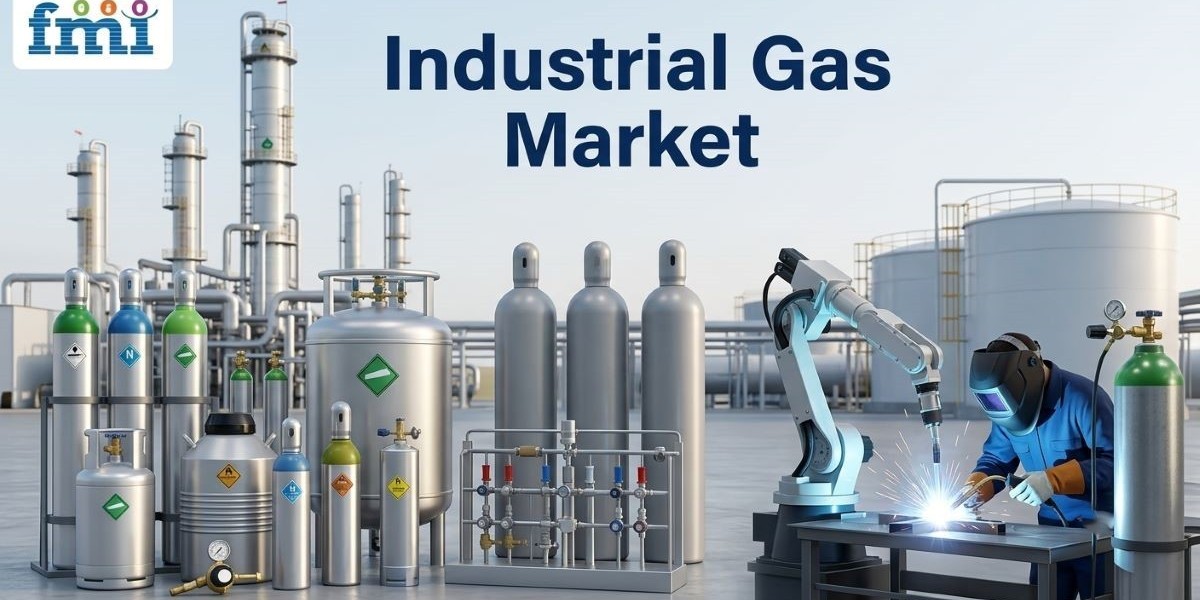

According to Future Market Insights (FMI), the industrial gas market is valued at USD 81 billion in 2025. The market is projected to reach USD 87.3 billion in 2026 and USD 184.9 billion by 2036, expanding at a 7.8% CAGR from 2026 to 2036. Oxygen is projected to account for 32.0% of gas type demand in 2026, while manufacturing is expected to represent 34.0% of end-use demand.
Industrial gas demand continues to track the performance of process-intensive industries that require oxygen, nitrogen, hydrogen, carbon dioxide and argon for continuous production, safety and quality control. Large industrial buyers are increasingly favoring dependable supply arrangements, including on-site plants, long-term contracts and backup systems, rather than relying solely on short-term merchant purchases.
Get detailed market forecasts, competitive benchmarking, and pricing trends: https://www.futuremarketinsights.com/reports/sample/rep-gb-15908
Why is the Industrial Gas Market Growing?
The industrial gas market is supported by several sectors where gas availability directly affects production continuity. Steelmakers require oxygen for furnace productivity and cutting operations, while chemical and refining facilities use hydrogen and nitrogen across process applications. Healthcare systems maintain medical oxygen capacity for routine treatment and emergency preparedness, and electronics manufacturers depend on high-purity nitrogen and argon to protect sensitive production environments.
Steel remains one of the strongest anchors for oxygen demand. World Steel Association data show that China produced 1,005.1 million tonnes of crude steel in 2024, highlighting the scale of industrial gas requirements around major metal-producing regions. Large steel plants often require continuous oxygen supply, making reliability, backup capacity and proximity to production sites important purchasing considerations.
Market Segmentation Analysis
Oxygen is projected to lead gas type demand with a 32.0% share in 2026, supported by steelmaking, healthcare, cutting and other high-volume applications.
On-site supply is estimated to account for 38.0% of supply mode demand in 2026, reflecting the preference of large industrial users for dedicated production assets and dependable gas availability.
Manufacturing is expected to represent 34.0% of end-use demand in 2026, supported by metal processing, welding, cutting and heat-treatment activities.
Industrial grade gases are projected to account for 46.0% of purity grade demand in 2026, reflecting their broad use across factories and process industries.
Metal processing is anticipated to lead application demand with a 29.0% share in 2026, supported by oxygen cutting and furnace operations requiring dependable gas flow.
The Industrial Gas Market covers gas types including Oxygen, Nitrogen, Hydrogen, Carbon Dioxide and Argon; supply modes including On-site Supply, Bulk Liquid, Cylinder Supply and Pipeline Supply; end uses including Manufacturing, Chemicals, Healthcare, Electronics and Energy; purity grades including Industrial Grade, Medical Grade, Food Grade and Electronics Grade; and applications including Metal Processing, Inerting, Freezing, Welding and Blanketing.
Supply Reliability Strengthens the Role of On-site Gas
Large industrial buyers increasingly prefer on-site production when gas demand is predictable and continuous. Dedicated plants can reduce dependence on external transportation and provide a stable supply for facilities where interruptions could affect furnaces, reactors, hospitals or electronics production.
Bulk liquid and cylinder supply remain important for intermittent or smaller-volume users. This creates a multi-layered supply structure in which large users often rely on dedicated production, while smaller customers depend on merchant liquid and packaged gas networks.
The competitive advantage therefore extends beyond product availability. Suppliers need plant engineering capabilities, backup systems, cryogenic logistics and long-term service structures to support demanding industrial customers.
Country-Level Industrial Gas Market Outlook
India is projected to record the fastest country growth at a 9.3% CAGR through 2036, supported by steel capacity expansion, healthcare infrastructure and refining activity. Odisha and Chhattisgarh steel belts represent important oxygen demand centers, while Gujarat's refinery and chemical clusters create opportunities for hydrogen and nitrogen applications.
Saudi Arabia is expected to expand at an 8.4% CAGR through 2036, driven by refining, petrochemicals, hydrogen and chemical projects. Industrial clusters in Jubail and Yanbu require nitrogen blanketing and hydrogen supply across process operations.
China is forecast to grow at an 8.1% CAGR through 2036. Its large steel base continues to support oxygen and nitrogen demand, while electronics manufacturing in the Yangtze River Delta increases requirements for high-purity gases.
The United States is expected to advance at a 7.6% CAGR through 2036, supported by refinery hydrogen, semiconductor production and mission-critical cryogenic gas applications.
South Korea is projected to rise at a 7.2% CAGR through 2036, with semiconductor fabs supporting high-purity nitrogen and argon demand alongside established steelmaking requirements.
Germany is forecast to grow at a 6.4% CAGR through 2036, with metals, chemicals, healthcare and decarbonization initiatives supporting demand for oxygen, nitrogen and hydrogen.
Brazil is expected to post a 6.1% CAGR through 2036, supported by steel and food processing. Carbon dioxide and nitrogen remain relevant to freezing and modified-atmosphere packaging applications.
Competitive Landscape and Strategic Positioning
The industrial gas market is moderately concentrated, with Linde, Air Liquide and Air Products maintaining broad global supply networks. Competition centers on supply uptime, on-site plant ownership, bulk liquid reach, high-purity gas capabilities and technical support.
Regional and merchant specialists compete through cylinder networks, liquid delivery and local plant coverage. Messer, Nippon Sanso Holdings, SOL Group and INOX Air Products hold positions across selected geographic and application markets.
Specialty suppliers such as Matheson Tri-Gas, Taiyo Nippon Sanso and Coregas serve high-purity and electronics-grade requirements where documentation and technical service are important.
Recent developments reinforce the strategic importance of industrial gas infrastructure. In July 2025, Linde announced major U.S. investments including a Brownsville ASU to deliver liquid oxygen, nitrogen and argon for space-sector demand. In January 2026, Air Products won NASA contracts to supply about 36.5 million pounds of liquid hydrogen, highlighting the importance of mission-critical cryogenic gas supply. In December 2025, Air Liquide announced an expansion and electrification of its oxygen facility in Shaanxi, supporting lower-carbon industrial oxygen production in China.
Analyst Perspective
“Nikhil Kaitwade, Associate Vice President at Future Market Insights, says, “I view industrial gases as a production-critical market, not a discretionary input category. Buyers place supply reliability before price when gases feed furnaces, reactors, hospitals or chip lines. Oxygen and nitrogen form the volume base. Hydrogen and specialty gases are changing how suppliers plan assets.”
Market Snapshot
- 2026 market value: USD 87.3 billion
- 2036 projected value: USD 184.9 billion
- CAGR, 2026–2036: 7.8%
- Leading gas type in 2026: Oxygen
- Oxygen share in 2026: 32.0%
- Leading end-use in 2026: Manufacturing
- Manufacturing share in 2026: 34.0%
- Fastest-growing country: India
- India CAGR, 2026–2036: 9.3%
About the Report
The Industrial Gas Market analysis from Future Market Insights covers Oxygen, Nitrogen, Hydrogen, Carbon Dioxide and Argon across on-site supply, bulk liquid, cylinder supply and pipeline supply modes. The study analyzes demand across Manufacturing, Chemicals, Healthcare, Electronics and Energy end-use sectors, along with Industrial Grade, Medical Grade, Food Grade and Electronics Grade purity categories.
The report also evaluates applications including Metal Processing, Inerting, Freezing, Welding and Blanketing. Geographic analysis covers major global regions, with detailed country-level assessment including India, Saudi Arabia, China, the United States, South Korea, Germany and Brazil.
Key companies profiled in the Industrial Gas Market include Linde, Air Liquide, Air Products, Messer, Nippon Sanso Holdings, SOL Group, INOX Air Products, Matheson Tri-Gas, Taiyo Nippon Sanso and Coregas. The competitive assessment evaluates relative positioning based on on-site ASU depth, merchant liquid reach, high-purity gas coverage and geographic footprint.
Explore More Related Studies Published by FMI Research:
https://www.openpr.com/news/4581257/united-kingdom-welding-consumables-market-reaches-usd-3-4
https://www.openpr.com/news/4581264/uv-resistant-masterbatches-market-reaches-usd-2-8-billion
https://www.openpr.com/news/4581279/busbar-potting-compounds-market-reaches-usd-1-9-billion-fueled
FMI Custom Research: Strategic Intelligence for Confident Decision-Making
In today's rapidly evolving healthcare environment, leadership teams need more than market data—they need actionable intelligence tailored to their strategic priorities. FMI's Custom Research solutions help organizations evaluate growth opportunities, validate investments, assess competitive dynamics, understand technology adoption, and reduce uncertainty before making critical business decisions.
Key Executive Benefits
- Decision-Ready Insights: Research tailored to specific business challenges, expansion plans, technology priorities, and investment requirements.
- Reduced Strategic Risk: Validate market opportunities, customer demand, competitive positioning, and technology adoption before committing resources.
- Market Entry Confidence: Assess opportunity size, regulatory barriers, distribution dynamics, healthcare infrastructure, and competitive landscapes.
- Competitive Advantage: Gain proprietary intelligence unavailable through syndicated reports or internal datasets.
- Faster Growth Decisions: Accelerate market expansion, product development, portfolio optimization, partnerships, and investment planning.
Business Impact
FMI helps organizations transform market complexity into strategic clarity, enabling leadership teams to identify growth opportunities faster, optimize resource allocation, strengthen competitive positioning, and make high-stakes business decisions with confidence.
To explore how FMI Custom Research can support your strategic priorities, connect with the team at sales@futuremarketinsights.com