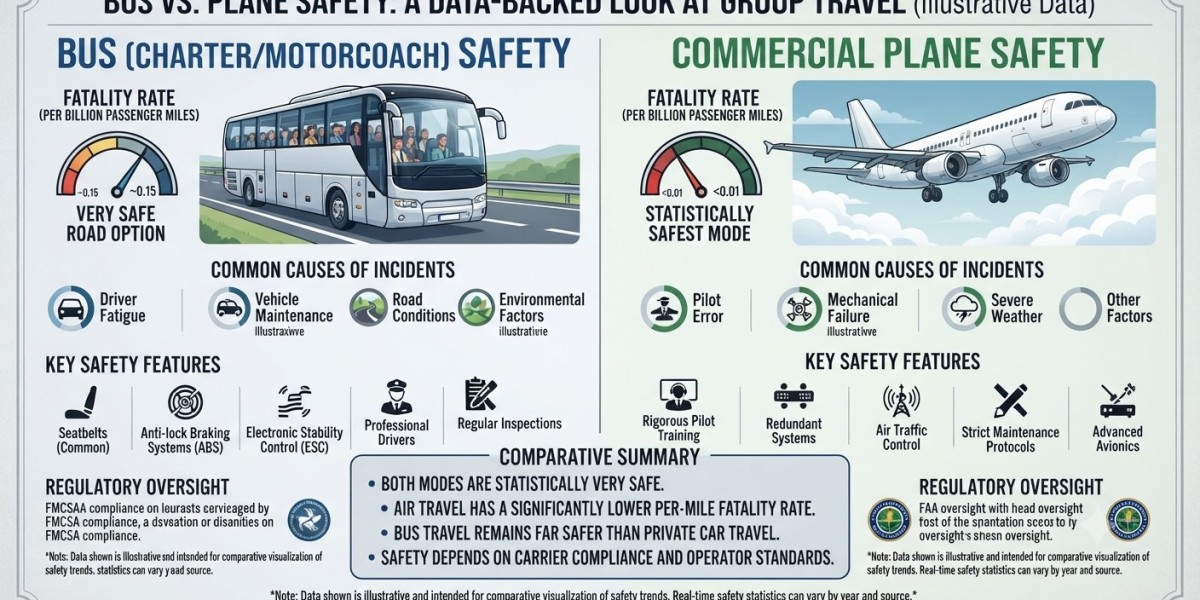

When a large group is planning a trip, transportation safety deserves careful attention. Schools, sports teams, corporate organizations, wedding parties, and families often compare charter buses with airplanes before deciding how to travel. Understanding group transportation safety can help planners evaluate these options based on professional drivers, regulatory oversight, vehicle standards, and the overall travel experience.
A direct bus-versus-plane comparison is not always straightforward. Each transportation method operates under different regulations and covers different distances. Looking at the available safety information alongside the practical circumstances of a trip provides a more useful perspective.
How Safe Are Charter Buses?
The Federal Motor Carrier Safety Administration (FMCSA) states that bus travel is among the safest forms of passenger transportation. The agency provides safety information and resources for commercial passenger carriers and travelers.
Interstate charter bus operators are subject to federal requirements covering areas such as driver qualifications, vehicle maintenance, operating authority, insurance, and hours of service. These requirements establish important safety standards for commercial passenger transportation.
However, the safety record of the individual company still matters. FMCSA recommends researching a bus operator before booking and checking its available safety information.
How Safe Is Air Travel?
Commercial aviation is also subject to extensive federal oversight. The Federal Aviation Administration maintains aviation safety information covering accident and incident records, aircraft operators, pilots, mechanics, repair stations, and other areas.
Airlines operate under detailed requirements involving aircraft maintenance, flight operations, crew qualifications, and passenger safety procedures.
This extensive oversight has made commercial aviation one of the most established forms of long-distance transportation.
Why Comparing Safety Data Can Be Complicated
Transportation safety statistics can be presented in several ways. Researchers may consider incidents or fatalities per passenger mile, per trip, or according to other exposure measurements.
This matters because buses and airplanes operate at very different distances and speeds.
A plane may travel thousands of miles during one journey, while a charter bus might travel several hundred miles. Simply comparing the total number of accidents therefore does not provide enough information to determine relative safety.
A data-backed comparison needs to consider how the statistics were calculated and what type of travel they represent.
Professional Drivers Are an Important Safety Factor
One major feature of charter bus travel is the use of professional commercial drivers.
Instead of requiring a large group to divide among multiple rental cars, a charter bus allows passengers to travel together with a qualified driver operating the vehicle.
FMCSA advises travelers to select companies that use qualified, licensed drivers with good safety records.
Professional drivers can also be especially useful when a group is traveling on unfamiliar roads. Passengers can focus on the trip instead of navigating traffic or coordinating several vehicles.
Charter Bus Maintenance and Inspections
Vehicle maintenance is another important part of passenger safety.
FMCSA recommends selecting bus companies that regularly inspect, maintain, and repair their fleets. Travelers can also review an operator's safety information before booking.
A group organizer should therefore consider more than the appearance or age of a bus. The company's maintenance practices and safety record provide more meaningful information.
FMCSA's safety search resources allow travelers to examine information about applicable interstate passenger carriers, including safety performance and authorization status.
Aircraft Safety Depends on Similar Principles
Although aircraft and buses are very different vehicles, both transportation systems depend on maintenance, qualified professionals, inspections, and regulatory oversight.
The FAA maintains data relating to aircraft operators, accidents and incidents, mechanics, repair stations, and service difficulties.
These systems allow aviation authorities and industry professionals to monitor safety information and address potential problems.
For travelers, this reinforces an important point: the quality of the operator matters regardless of which transportation method is selected.
The Group Travel Advantage of a Charter Bus
A charter bus offers a practical advantage for large groups because everyone can travel together.
If 40 people use eight or ten separate cars, several drivers must navigate the same route. Vehicles can become separated, and every driver is responsible for handling traffic, road conditions, parking, and navigation.
A charter bus consolidates the group into one vehicle.
This can simplify transportation for school field trips, sporting events, corporate conferences, weddings, concerts, and family gatherings.
Keeping the group together can also make it easier for organizers to coordinate departure times and arrivals.
When Flying Makes More Sense
Flying can be the better option for very long-distance travel.
A commercial aircraft can cover hundreds or thousands of miles in significantly less time than a bus. For travelers with limited schedules, this can be an important advantage.
Air travel may therefore make sense when the destination is far away or when reaching the destination quickly is the primary concern.
However, the flight is only one part of the overall journey. Travelers may also need transportation to the airport, security screening, boarding, baggage collection, and transportation from the destination airport.
For large groups, these additional stages can require careful coordination.
When a Charter Bus Is the Better Choice
Charter buses are often well suited to short- and medium-distance group travel.
A bus can pick passengers up at a designated location and take them directly to an event, hotel, venue, campus, or other destination.
This can eliminate the need for multiple rental cars and reduce the number of individual drivers involved.
Charter buses can be especially convenient for groups that need to arrive and depart together.
How to Check a Charter Bus Company's Safety Record
Before booking a charter bus, organizers should research the company.
FMCSA recommends that travelers look before they book by checking a carrier's safety history. Its online resources allow users to search by company name or USDOT number and review information about the carrier.
Organizers should pay attention to the company's operating authorization, insurance information, safety performance, and available safety rating.
FMCSA also identifies several areas that travelers should consider, including unsafe driving, hours-of-service compliance, vehicle maintenance, controlled substances and alcohol, and driver fitness.
This research can be more useful than choosing a transportation company solely because it offers the lowest price.
Charter Bus vs. Plane: Which Is Safer?
There is no universal answer that makes charter buses or airplanes safer for every possible journey.
FMCSA describes bus travel as among the safest forms of passenger transportation, while commercial aviation operates under extensive federal oversight and maintains detailed safety data.
The appropriate option depends on the distance, group size, schedule, route, and transportation provider.
For a cross-country journey where time is limited, flying may be the most practical option. For a regional group trip, a charter bus can offer professional driving, centralized transportation, and convenient pickup and drop-off arrangements.
Safety Should Come Before Price
Cost is an important part of group travel planning, but it should not be the only consideration.
FMCSA specifically advises organizations to consider safety when selecting a charter bus company and to research the operator before booking.
A responsible group planner should verify the carrier's credentials and investigate its safety history. Asking about driver qualifications, vehicle maintenance, insurance, and operating procedures can also help travelers make a more informed decision.
Final Thoughts
Comparing bus and plane safety requires more than looking at isolated accident statistics. Both transportation methods operate under extensive safety requirements, but their operating environments, distances, and risks are different.
For charter bus travel, selecting a reputable operator is one of the most important safety decisions a group can make. Researching the company's safety record, authorization, insurance, driver qualifications, and maintenance practices can help organizers choose responsibly.
Ultimately, the best transportation option depends on the specific trip. By considering safety alongside distance, schedule, group size, and logistics, travelers can select transportation that provides an appropriate balance of safety and convenience.