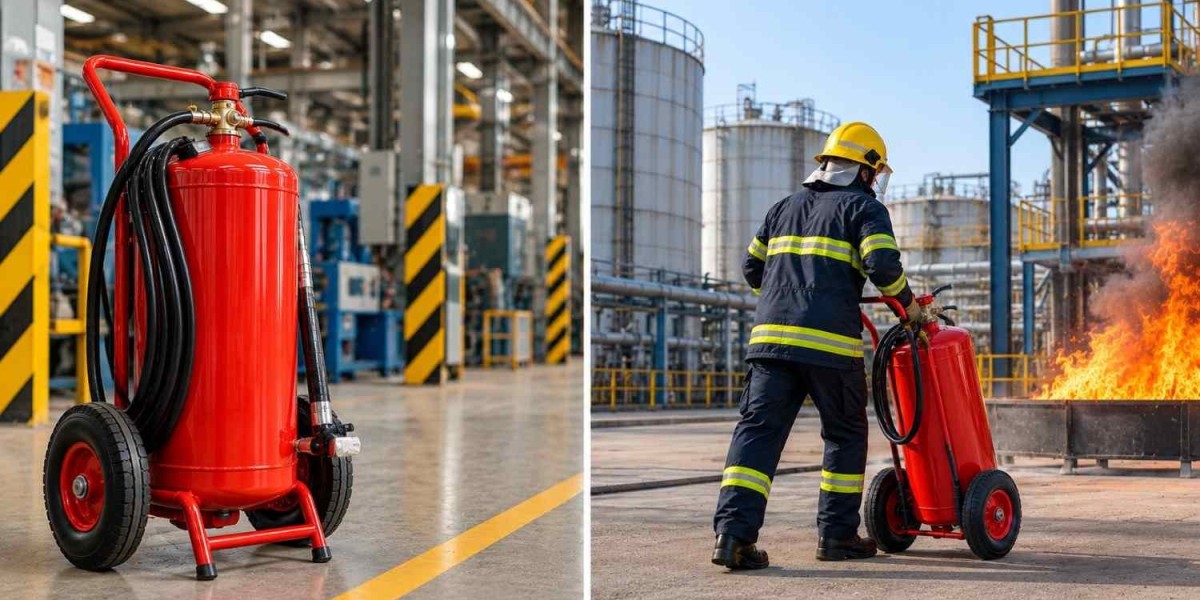

Fire safety is a major concern in industrial facilities where machines, electrical equipment, fuels, chemicals, and other combustible materials may be present. A small fire can quickly become a serious problem if the right equipment is not available nearby. For this reason, many factories, warehouses, workshops, manufacturing plants, and large commercial facilities use wheeled fire protection systems.
A fire extinguisher trolley provides a practical way to carry a larger amount of extinguishing agent to the location where it is needed. Unlike smaller handheld extinguishers, wheeled systems are designed for situations where a fire may require greater extinguishing capacity and longer operating time.
What Is a Wheeled Fire Protection System?
A wheeled fire protection system is basically a large-capacity fire extinguisher mounted on a trolley or wheeled frame. The wheels make it easier for workers or trained safety personnel to move the equipment from one area to another.
Depending on the type of fire risk, these systems may use dry chemical powder, foam, carbon dioxide, or other suitable extinguishing agents. The right option depends on the materials, machinery, fuels, and electrical systems present at the facility.
Industrial sites often cover a much larger area than homes, offices, or small shops. Because of this, having equipment that combines mobility with higher extinguishing capacity can be highly useful.
Higher Extinguishing Capacity for Industrial Risks
One of the main reasons industrial facilities prefer wheeled systems is their larger capacity. A small portable extinguisher may be suitable for dealing with an early-stage fire, but certain industrial environments can involve greater fire loads.
Factories may contain raw materials, packaging products, lubricants, electrical installations, machinery, or flammable liquids. When a fire occurs around such materials, more extinguishing agent may be required.
A fire extinguisher trolley allows facilities to keep a larger quantity of extinguishing media ready for emergency use. This can give trained personnel better support while responding to an incident during its initial stage.
Easy Movement Across Large Facilities
Industrial buildings can be spread across large areas. Carrying a heavy extinguisher manually over a long distance may be difficult, especially during an emergency.
Wheeled fire protection systems solve this problem by placing the extinguisher cylinder on a movable frame. Workers can roll the unit toward the required location instead of lifting and carrying a heavy cylinder.
This mobility can be particularly useful in warehouses, loading areas, manufacturing floors, power-related facilities, workshops, storage zones, and other spacious industrial environments.
However, facilities should always keep access routes clear so that fire protection equipment can be moved without unnecessary obstacles.
Suitable for Different Industrial Fire Hazards
Not every industrial fire has the same cause. Some fires involve ordinary combustible materials, while others may involve flammable liquids, gases, or energized electrical equipment.
This is why choosing the correct extinguishing agent is extremely important.
For example, dry chemical powder systems are commonly considered where multiple types of fire hazards may be present. Foam-based systems may be appropriate for certain flammable-liquid risks, while CO2 systems can be useful for some electrical applications because they do not leave the type of residue associated with dry chemical powder.
The selection should always be based on a proper fire risk assessment and applicable fire safety requirements.
Longer Discharge and Better Reach
Another benefit of wheeled systems is their ability to carry significantly more extinguishing agent than typical portable units. Depending on the model, this may provide a longer discharge period and help trained users respond from a practical operating position.
Many wheeled extinguishers are equipped with a hose and discharge nozzle. This arrangement can help the operator direct the extinguishing agent toward the fire while positioning the main cylinder at a suitable location.
The equipment must still be operated according to its instructions, and employees expected to use it should receive proper fire safety training.
Useful for High-Risk Areas
Certain parts of an industrial facility may have a greater fire risk than others. Generator areas, fuel storage zones, chemical processing sections, machinery areas, loading zones, and electrical installations are examples where additional fire protection may be considered.
Strategically placing a fire extinguisher trolley near identified high-risk areas can help improve emergency preparedness. The equipment should be positioned where it is visible, accessible, and protected from unnecessary damage.
Placement should be determined through a proper assessment rather than simply putting large extinguishers wherever space is available.
Reduces the Difficulty of Handling Large Extinguishers
Large extinguisher cylinders can be extremely heavy. Trying to carry such equipment manually would be impractical for many workers.
A strong wheeled frame makes transportation much easier. Handles and wheels allow trained users to move the equipment with less physical effort compared with carrying a large cylinder.
Facilities should also inspect wheels, hoses, nozzles, pressure indicators, cylinders, and other components regularly. A trolley system is useful only when it remains functional and ready for emergency operation.
Supporting an Overall Industrial Fire Safety Plan
Wheeled extinguishers should not be treated as a replacement for every other fire safety measure. Industrial facilities normally need a combination of prevention, detection, emergency planning, evacuation procedures, alarms, suitable extinguishers, and other fire protection systems based on their risks.
Regular inspections and maintenance are equally important. Employees should know where fire equipment is located, how to report an emergency, and when evacuation is safer than attempting to fight a fire.
Companies such as Savemax provide fire protection equipment designed for different industrial and commercial applications. Selecting equipment according to the actual fire hazards of a facility helps businesses build a more practical and dependable safety setup.
Conclusion
Industrial facilities prefer wheeled fire protection systems because they combine mobility with higher extinguishing capacity. They can be particularly valuable in large factories, warehouses, workshops, and other locations where significant fire hazards may exist.
A properly selected fire extinguisher trolley can make larger-capacity firefighting equipment easier to move and position during an emergency. However, equipment selection, placement, inspection, maintenance, and employee training all play an important role.
By understanding site-specific fire risks and choosing suitable protection equipment, industrial facilities can strengthen their emergency preparedness and create a safer working environment for people, property, and operations.
Read More: