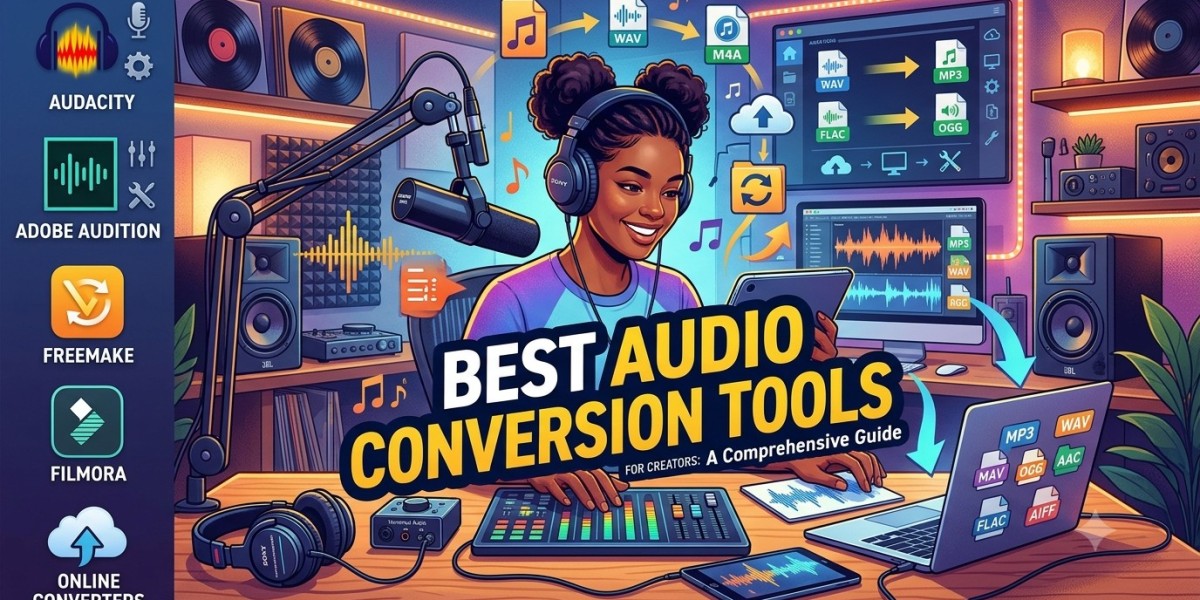

Creating digital content often means working with many different audio formats. A podcast may need one format, a video editor may prefer another, and a social media platform may have its own requirements. For creators, having a dependable audio conversion tool can make these tasks much easier.
Audio converters help change files from one format to another while giving users control over factors such as quality, bitrate, and file size. The right tool can save time, reduce compatibility problems, and make audio easier to edit, share, or publish. Modern options range from simple browser-based converters to advanced desktop applications designed for professional workflows.
Why Audio Conversion Matters for Creators
Audio is an important part of videos, podcasts, online courses, social media content, music projects, and presentations. However, not every application supports every audio format.
For example, WAV files are commonly useful during professional editing because they can contain uncompressed PCM audio, while MP3 is popular when smaller file sizes and broad compatibility are more important. FLAC provides a lossless option that can reduce storage requirements compared with uncompressed audio without discarding the original audio information.
Conversion becomes particularly useful when creators move files between editing software, publishing platforms, mobile devices, and storage systems.
What Makes a Good Audio Converter?
Not every converter is equally suitable for content creation. Before choosing one, creators should consider how easy it is to use, which formats it supports, and whether it provides enough control over the final file.
Format Support
A useful converter should support commonly used formats such as WAV, MP3, FLAC, AAC, M4A, OGG, and AIFF. Broader format support is especially helpful for creators who work across multiple platforms.
Output Quality
Quality settings can affect both sound and file size. A good converter should allow users to select suitable bitrate and other output settings instead of automatically applying one fixed configuration.
Batch Conversion
Creators working with multiple recordings can save considerable time with batch processing. Instead of converting files individually, batch-capable tools can process an entire collection in one operation. Tools such as fre:ac, FFmpeg, and several desktop converters provide options for handling multiple files.
Ease of Use
Advanced controls are useful, but they should not make basic conversion unnecessarily complicated. Beginners may prefer a simple interface where they can upload a file, select the desired format, and start the conversion.
Best Audio Conversion Tools for Different Needs
There is no single converter that is perfect for every creator. The best choice depends on the type of work being done.
Audacity for Editing and Conversion
Audacity is a popular open-source audio application that combines editing and conversion capabilities. This makes it useful for creators who want to clean up recordings before exporting them.
Instead of switching between separate editing and conversion programs, users can import audio, make basic adjustments, and export it into a suitable format. It supports several common formats, including WAV, MP3, FLAC, OGG, AIFF, and WMA.
It is particularly useful for podcasters, educators, voice-over creators, and beginners who need both editing and format conversion.
FFmpeg for Advanced Workflows
FFmpeg is better suited to users who are comfortable with technical tools and command-line workflows. It supports a very large range of audio and video formats and can be used for automation.
For creators who regularly process hundreds of files, automation can be a major advantage. Instead of manually converting each recording, users can create commands or scripts that process files according to predefined settings.
The main drawback is that FFmpeg has a steeper learning curve than graphical applications.
fre:ac for Batch Conversion
fre:ac is a strong choice for creators who want a free desktop converter with batch-processing capabilities. It supports numerous audio formats and can handle large collections without requiring users to convert files individually.
Its main strength is efficiency. Someone organizing a large collection of recordings can add multiple files to a queue and select the desired output format before starting the conversion.
MediaHuman Audio Converter for Simplicity
Creators who prefer a straightforward graphical interface may find MediaHuman Audio Converter easier to approach. It supports common formats such as MP3, FLAC, AAC, WAV, OGG, AIFF, and WMA and also supports batch conversion.
This type of tool is useful when the primary goal is quick conversion rather than detailed audio editing.
VLC Media Player for Convenient Conversion
Many creators already have VLC installed for playing media files. VLC can also perform basic audio conversion, which makes it a convenient option when installing another application is unnecessary.
It supports formats including MP3, FLAC, AAC, WAV, and OGG.
VLC may not offer the same specialized workflow as dedicated audio-conversion software, but it can be practical for occasional conversions.
Online Audio Converters
Browser-based converters can be useful when creators do not want to install software. They generally allow users to upload an audio file, choose an output format, and download the converted result.
Online tools are convenient for quick, one-off tasks, particularly when working from a computer where software installation is restricted. However, creators should pay attention to upload limits, supported formats, privacy policies, and whether files are stored on remote servers.
For sensitive recordings, unpublished projects, client material, or private interviews, a trusted local application may be preferable because the files can remain on the creator's own computer.
Choosing the Right Audio Format
Selecting the correct output format is just as important as selecting the converter.
WAV
WAV is commonly used for recording, editing, production, and professional workflows. It can provide uncompressed PCM audio but generally requires more storage space than compressed formats.
For creators who expect to continue editing a recording, keeping a high-quality lossless master is a sensible approach.
MP3
MP3 remains popular because of its small file size and broad compatibility. It can be useful for sharing, basic distribution, podcasts, and situations where storage or bandwidth matters.
However, MP3 is a lossy format, meaning some audio information is removed during encoding. Converting an already compressed file into another lossy format can introduce additional quality loss.
FLAC
FLAC is a lossless format that can reduce file size without permanently removing audio information. It is useful for archiving music and maintaining high-quality audio collections.
Creators who want a smaller archive than WAV while retaining lossless quality may find FLAC particularly useful.
AAC and M4A
AAC is another lossy format designed to provide efficient compression. M4A is commonly used as a container for AAC audio. These formats can be practical for modern media workflows where a balance between quality and file size is important.
A Practical Example for Creators
Suppose a creator has an audio track inside a video and needs a standalone WAV file for editing. A suitable converter can extract or convert the audio into the required format.
This is where a tool for youtube to wav conversion may be relevant when the creator has the necessary rights or permission to use the source material. The important consideration is not simply changing the extension but actually converting the audio into the required format while selecting appropriate quality settings.
Creators should also remember that converting a low-quality source into WAV does not magically restore missing audio information. A larger file does not automatically mean better sound quality.
Best Practices for Audio Conversion
Good conversion habits can help creators maintain consistent quality across projects.
Keep a High-Quality Master
Whenever possible, retain the original lossless recording before creating compressed versions. This provides a clean source for future exports.
Avoid Repeated Lossy Conversion
Repeatedly converting between lossy formats can reduce quality. For example, taking an MP3, converting it to another lossy format, and then converting it again can introduce additional artifacts. It is better to return to the original lossless source when creating a new version.
Choose Settings Based on the Final Purpose
Do not automatically choose the highest bitrate available. A large WAV may be appropriate for editing, while a smaller MP3 or AAC file may be more practical for sharing.
Think about where the file will be used before selecting the output settings.
Understanding Audio Conversion
Audio Conversion is essentially the process of changing audio from one format or encoding method to another. Understanding the difference between lossless and lossy formats helps creators make better decisions about quality, storage, and compatibility.
A simple workflow is to keep the original recording as a high-quality master, edit from that source, and then create separate delivery files for different platforms. This approach reduces unnecessary conversions and provides greater flexibility for future projects.
How to Choose the Best Tool
The best converter depends on your workflow rather than simply the number of formats a tool supports.
If you need editing alongside conversion, Audacity can be a practical choice. For automation and advanced processing, FFmpeg offers extensive control. For large collections, fre:ac can make batch conversion easier. Users who want a straightforward interface can consider tools such as MediaHuman Audio Converter, while VLC can be convenient for occasional conversions.
The important thing is to choose a tool that matches your technical experience, project size, privacy requirements, and final publishing destination.
Final Thoughts
Audio conversion does not have to be complicated. Once creators understand the differences between WAV, MP3, FLAC, AAC, and other formats, choosing the right output becomes much easier. A good converter can simplify everyday tasks, support efficient workflows, and help maintain suitable quality for different publishing needs.
Whether you are producing podcasts, videos, music, tutorials, or social media content, the best approach is to maintain a high-quality original and create optimized copies when necessary. OutRight Systems encourages creators to focus on practical workflows, reliable tools, and informed format choices so their audio remains useful across different projects and platforms.